



Question: Consider the following Ricardian example with many goods, using standard Ricardian assumptions. There are two countries: Argentina and Chile. The unit labor requirements for Argentina
Consider the following Ricardian example with many goods, using standard Ricardian assumptions. There are two countries: Argentina and Chile. The unit labor requirements for Argentina are denoted by aLi and for Chile by aLi*
a)Clearly state which country has an absolute advantage in each of the 5 goods.
b) What condition determines if a country has a comparative advantage in a good?
c)Now suppose the wage in Argentina, ? = 15 and the wage in Chile, ? ? = 10, which goods does Argentina have a comparative advantage in? Which goods does Chile have a comparative advantage in?
d) What if the wage in Argentina, ? = 25 and the wage in Chile, ? ? = 10? Which goods does Argentina have a comparative advantage in? Which goods does Chile have a comparative advantage in?
e)Assume that the wage is same as in part d). Suppose that transportation costs were 20% of production costs (note that the production cost here is simply the labor cost). Will this lead to any good becoming a non-traded good?
f) Assume that the wage is same as in part d). Suppose that transportation costs were 100% of production costs. Will this lead to any good becoming a non-traded good

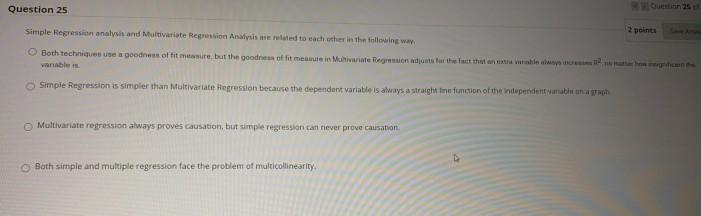

SP20 MATH 202 MW 9:15a-10:55a Homework: Recommended Problems for Section 4.1 Score: 0 of 1 pt 1 of 17 (0 complete) 4.1.1 What is the difference between univariate data and bivariate data? Choose the correct answer below. O A. In univariate data, the data are qualitative. In bivariate data, the data are quantitative. O B. In univariate data, there is one mean. In bivariate data, there are two means. O C. In univariate data, a single variable is measured on each individual. In bivariate data, two variables are measured on each individual. O D. In univariate data, there are only positive values and zeros. In bivariate data, there are positive values, negative values, and zeros. Click to select your answer and then click Check Answer All parts showing Clear All eQuestion 25 Simple Regression analysis and Mumvariate Regression Analysis me raised to each other in ihn following way; @) Both techniques use a goodness of fit musmire, but the goodness of fit meamie in Muhivanale Regression adjusts Nu the fact that an coun miinhis aduspammin Ingphompants Simple Regression is simpler than Multivariate Regression because the dependent variable is aways a straight line function of the independent sunable un a graph Multivariate regression always proves causation, but simple regression can never prove causation Both simple and multiple regression face the problem of multicollinearity\fQuestion 31 1 pts A correlation heat map is best used for: O Bivariate data when both columns are numeric Multivariate data when all columns are ordinal Multivariate data when all columns are nominal Multivariate data when all columns are numeric
Step by Step Solution
There are 3 Steps involved in it

Get step-by-step solutions from verified subject matter experts