







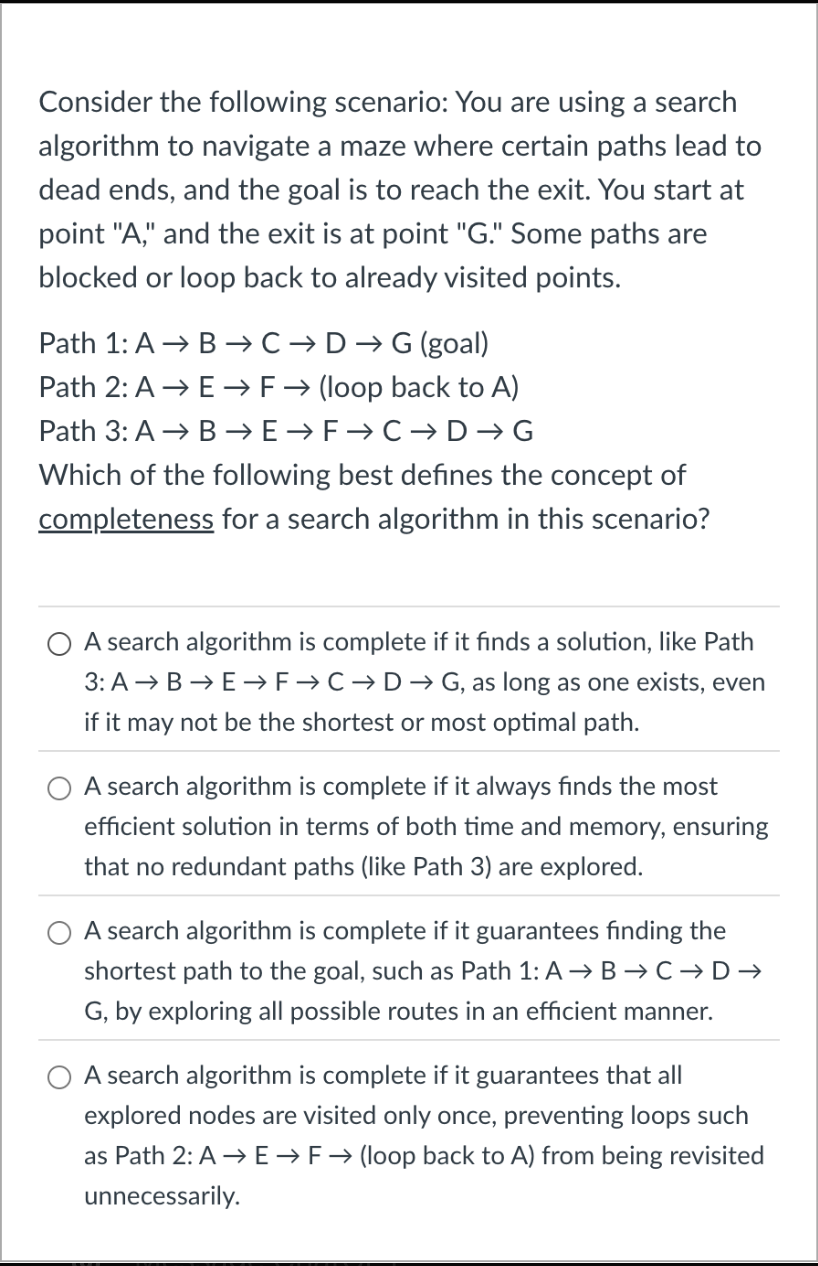
Question: Consider the following scenario: You are using a search algorithm to navigate a maze where certain paths lead to dead ends, and the goal is
Consider the following scenario: You are using a search
algorithm to navigate a maze where certain paths lead to
dead ends, and the goal is to reach the exit. You start at
point A and the exit is at point G Some paths are
blocked or loop back to already visited points.
Path : goal
Path : loop back to
Path :
Which of the following best defines the concept of
completeness for a search algorithm in this scenario?
A search algorithm is complete if it finds a solution, like Path
: as long as one exists, even
if it may not be the shortest or most optimal path.
A search algorithm is complete if it always finds the most
efficient solution in terms of both time and memory, ensuring
that no redundant paths like Path are explored.
A search algorithm is complete if it guarantees finding the
shortest path to the goal, such as Path :
G by exploring all possible routes in an efficient manner.
A search algorithm is complete if it guarantees that all
explored nodes are visited only once, preventing loops such
as Path : loop back to from being revisited
unnecessarily.
Step by Step Solution
There are 3 Steps involved in it
1 Expert Approved Answer
Step: 1 Unlock

Question Has Been Solved by an Expert!
Get step-by-step solutions from verified subject matter experts
Step: 2 Unlock
Step: 3 Unlock
 Study Help