





Question: Consider the following sequence of operations: stack ds; ds.push (MATH 270A.03) ds.push (CPSC 131.01); ds.pop ) ds.push(HIST 101.01) a) Assume that you are using a
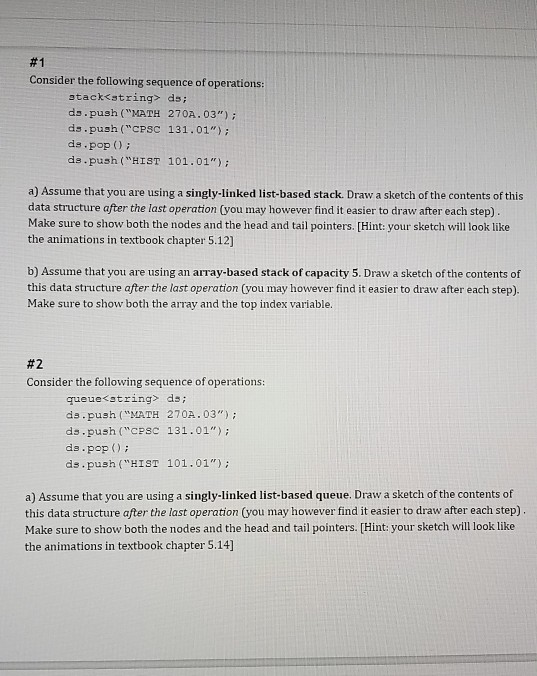
 Consider the following sequence of operations: stack ds; ds.push ("MATH 270A.03")

ds.push ("CPSC 131.01"); ds.pop ) ds.push(HIST 101.01") a) Assume that you are

Consider the following sequence of operations: stack ds; ds.push ("MATH 270A.03") ds.push ("CPSC 131.01"); ds.pop ) ds.push(HIST 101.01") a) Assume that you are using a singly-linked list-based stack. Draw a sketch of the contents of this data structure after the last operation (you may however find it easier to draw after each step) Make sure to show both the nodes and the head and tail pointers. [Hint: your sketch will look like the animations in textbook chapter 5.12] b) Assume that you are using an array-based stack of capacity 5. Draw a sketch of the contents of this data structure after the last operation (you may however find it easier to draw after each step). Make sure to show both the array and the top index variable. #2 Consider the following sequence of operations: queuecstring> ds; ds .push ("MATH 270A.03") ds push ("CPSC 131.01" ds.pop ); ds push ("HIST 101.01") a) Assume that you are using a singly-linked list-based queue. Draw a sketch of the contents of this data structure after the last operation (you may however find it easier to draw after each step) Make sure to show both the nodes and the head and tail pointers. (Hint your sketch will look like the animations in textbook chapter 5.14]

Step by Step Solution

There are 3 Steps involved in it

1 Expert Approved Answer
Step: 1 Unlock blur-text-image
Question Has Been Solved by an Expert!

Get step-by-step solutions from verified subject matter experts

Step: 2 Unlock
Step: 3 Unlock

Students Have Also Explored These Related Databases Questions!