







Question: Consider the following simpli e d version o f the model w e studied i n class. The world consists o f two countries, called
Consider the following simpli version the model studied class.
The world consists two countries, called home and foreign. All variables interest
rates are and measure deviations from zeroshock equilibrium levels. Foreign variables are
denoted with asterisk.
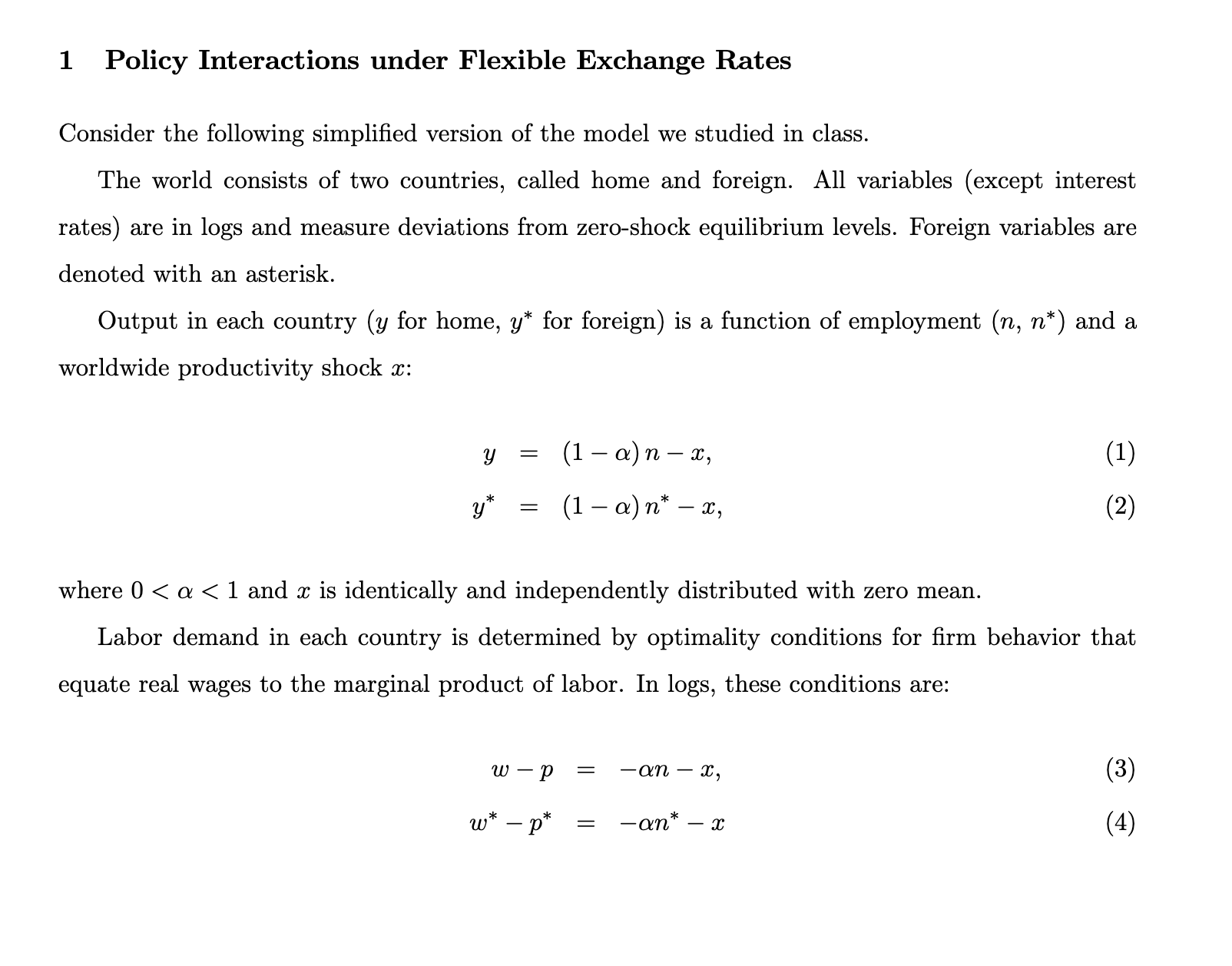
Output each country for home, for foreign a function employment and
worldwide productivity shock :
;
;
where and identically and independently distributed with zero mean.
Labor demand each country determined optimality conditions for behavior that
equate real wages the marginal product labor. these conditions are:
;
and are the nominal wages, and and are product prices.
Consumer price levels are given :
;
;
where the share spending the home good consumers each country
the nominal exchange rate home currency per unit foreign and the terms trade,
the home good per unit the foreign good
Expenditure equilibrium conditions for the home and foreign goods are:
;
;
where and and and are the ante real interest rates.
Denoting nominal interest rates with i and and are determined :
;
;
where
the expected value the home CPI one period ahead based
the currently available information.
Optimal bond holding behavior the two countries implies uncovered interest rate parity :
:
Proceeding the slides, use the ante real interest rate equations and UIP
the CPI equations and and the the terms trade
show that that equations and can rewritten :
;
:
Denoting money demand money supply equilibrium with home and
the foreign country, money market equilibrium each country requires:
;
:
Note: are simplifying the model studied class removing the interest rates
money demand. The money market equilibrium conditions above are thus analogous those
Barry Eichengreen model policy interactions under the interwar Gold Standard.
Proceeding the slides, show that prices and employment each country are such that:
;
;
and
;
:
Assume that and workers each country agree wages set the end the previous
period minimize the expected squared deviation employment from the zero shock equilibrium
each country. other words, chosen minimize
and chosen minimize
where denotes the expectation conditional information available the end
the previous period.
Assume that the exchange rate and central banks use the respective money supplies
their policy instruments. Central banks choose money supplies minimize loss functions that
depend the squared deviations CPI and employment from their zero shock levels.
other words, policymakers have motive move their money supplies other than responding
shocks:
;
;
where Assume that central banks care more about than employment,
Proceeding the slides, show that the assumptions are making imply that wage setting
results
Use a superscript denote the between home and foreign variables instance,
Use the money market equations and the expenditure equations
and equations and the result about wage setting above show that the
exchange rate determined :
:
Why didn have use the UIP equation part exchange rate determination like
the slides? : Think about the money demand equations and compare the exchange
rate solution above the one the slides.
Step by Step Solution
There are 3 Steps involved in it
1 Expert Approved Answer
Step: 1 Unlock

Question Has Been Solved by an Expert!
Get step-by-step solutions from verified subject matter experts
Step: 2 Unlock
Step: 3 Unlock
 Study Help