







Question: Consider the following statement about real options: Decision tree analysis is more commonly used in valuing securities than real assets. True or False: The preceding

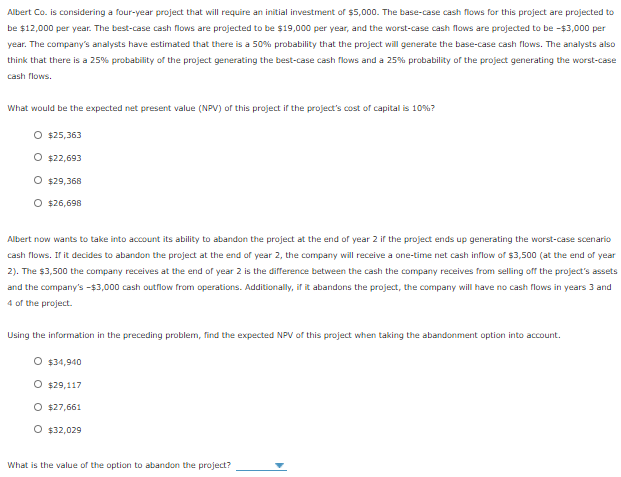
Consider the following statement about real options: Decision tree analysis is more commonly used in valuing securities than real assets. True or False: The preceding statement is correct. O False True Which type of real option allows a firm to shut down a project if its cash flows are lower than expected? Flexibility option O Timing option O Expansion option O Abandonment option Consider the following example: Clemens Inc. is considering a $100 million investment in a new line of soft drinks. However, $100 million is a huge investment for Clemens; if things turn bad, it could wipe out the company. A few senior managers have suggested a smaller investment of $20 million to see if the market is as strong as they hope it is. Ir demand is strong and the opportunity is still available, Clemens will increase its investment at a later date. This example describes a real option to Albert Co. is considering a four-year project that will require an initial investment of $5,000. The base-case cash flows for this project are projected to be $12,000 per year. The best-case cash flows are projected to be $19,000 per year, and the worst-case cash flows are projected to be - $3,000 per year. The company's analysts have estimated that there is a 50% probability that the project will generate the base-case cash flows. The analysts also think that there is a 25% probability of the project generating the best-case cash flows and a 25% probability of the project generating the worst-case cash flows. What would be the expected net present value (NPV) of this project if the project's cost of capital is 10%? 0 $25,363 O $22,693 O $29,368 O $26,698 Albert now wants to take into account its ability to abandon the project at the end of year 2 if the project ends up generating the worst-case scenario cash flows. If it decides to abandon the project at the end of year 2, the company will receive a one-time net cash inflow of $3,500 (at the end of year 2). The $3,500 the company receives at the end of year 2 is the difference between the cash the company receives from selling off the project's assets and the company's -$3,000 cash outflow from operations. Additionally, if it abandons the project, the company will have no cash flows in years 3 and 4 of the project. Using the information in the preceding problem, find the expected NPV of this project when taking the abandonment option into account. $34,940 O $29,117 O $27,661 O $32,029 What is the value of the option to abandon the project? Consider the following statement about real options: Decision tree analysis is more commonly used in valuing securities than real assets. True or False: The preceding statement is correct. O False True Which type of real option allows a firm to shut down a project if its cash flows are lower than expected? Flexibility option O Timing option O Expansion option O Abandonment option Consider the following example: Clemens Inc. is considering a $100 million investment in a new line of soft drinks. However, $100 million is a huge investment for Clemens; if things turn bad, it could wipe out the company. A few senior managers have suggested a smaller investment of $20 million to see if the market is as strong as they hope it is. Ir demand is strong and the opportunity is still available, Clemens will increase its investment at a later date. This example describes a real option to Albert Co. is considering a four-year project that will require an initial investment of $5,000. The base-case cash flows for this project are projected to be $12,000 per year. The best-case cash flows are projected to be $19,000 per year, and the worst-case cash flows are projected to be - $3,000 per year. The company's analysts have estimated that there is a 50% probability that the project will generate the base-case cash flows. The analysts also think that there is a 25% probability of the project generating the best-case cash flows and a 25% probability of the project generating the worst-case cash flows. What would be the expected net present value (NPV) of this project if the project's cost of capital is 10%? 0 $25,363 O $22,693 O $29,368 O $26,698 Albert now wants to take into account its ability to abandon the project at the end of year 2 if the project ends up generating the worst-case scenario cash flows. If it decides to abandon the project at the end of year 2, the company will receive a one-time net cash inflow of $3,500 (at the end of year 2). The $3,500 the company receives at the end of year 2 is the difference between the cash the company receives from selling off the project's assets and the company's -$3,000 cash outflow from operations. Additionally, if it abandons the project, the company will have no cash flows in years 3 and 4 of the project. Using the information in the preceding problem, find the expected NPV of this project when taking the abandonment option into account. $34,940 O $29,117 O $27,661 O $32,029 What is the value of the option to abandon the project
Step by Step Solution
There are 3 Steps involved in it

Get step-by-step solutions from verified subject matter experts
 Study Help