







Question: Consider the following statements about linear programming and the simplex method. Label each statement as true or false, and then justify your answer. In a
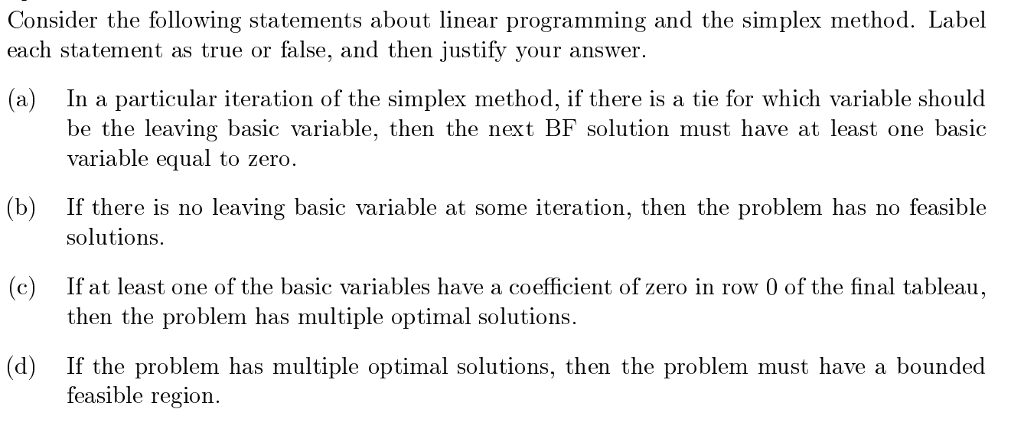
Consider the following statements about linear programming and the simplex method. Label each statement as true or false, and then justify your answer. In a particular iteration of the simplex method, if there is a tie for which variable shouldbe the leaving basic variable, then the next BF solution must have at least one basicvariable equal to zero. If there is no leaving basic variable at some iteration, then the problem has no feasiblesolutions. If at least one of the basic variables have a coefficient of zero in row 0 of the final tableau, then the problem has multiple optimal solutions. If the problem has multiple optimal solutions, then the problem must have a boundedfeasible region. Consider the following statements about linear programming and the simplex method. Label each statement as true or false, and then justify your answer. In a particular iteration of the simplex method, if there is a tie for which variable shouldbe the leaving basic variable, then the next BF solution must have at least one basicvariable equal to zero. If there is no leaving basic variable at some iteration, then the problem has no feasiblesolutions. If at least one of the basic variables have a coefficient of zero in row 0 of the final tableau, then the problem has multiple optimal solutions. If the problem has multiple optimal solutions, then the problem must have a boundedfeasible region
Step by Step Solution
There are 3 Steps involved in it
a False If there is a tie for which variable should be the leaving basic variable it indicates degen... View full answer

Get step-by-step solutions from verified subject matter experts
 Study Help