







Question: Consider the following table. (Note: This exercise corresponds to the subsection Model Choices.) Production, Given the Amount Invested in Capital Production, P (billion units)
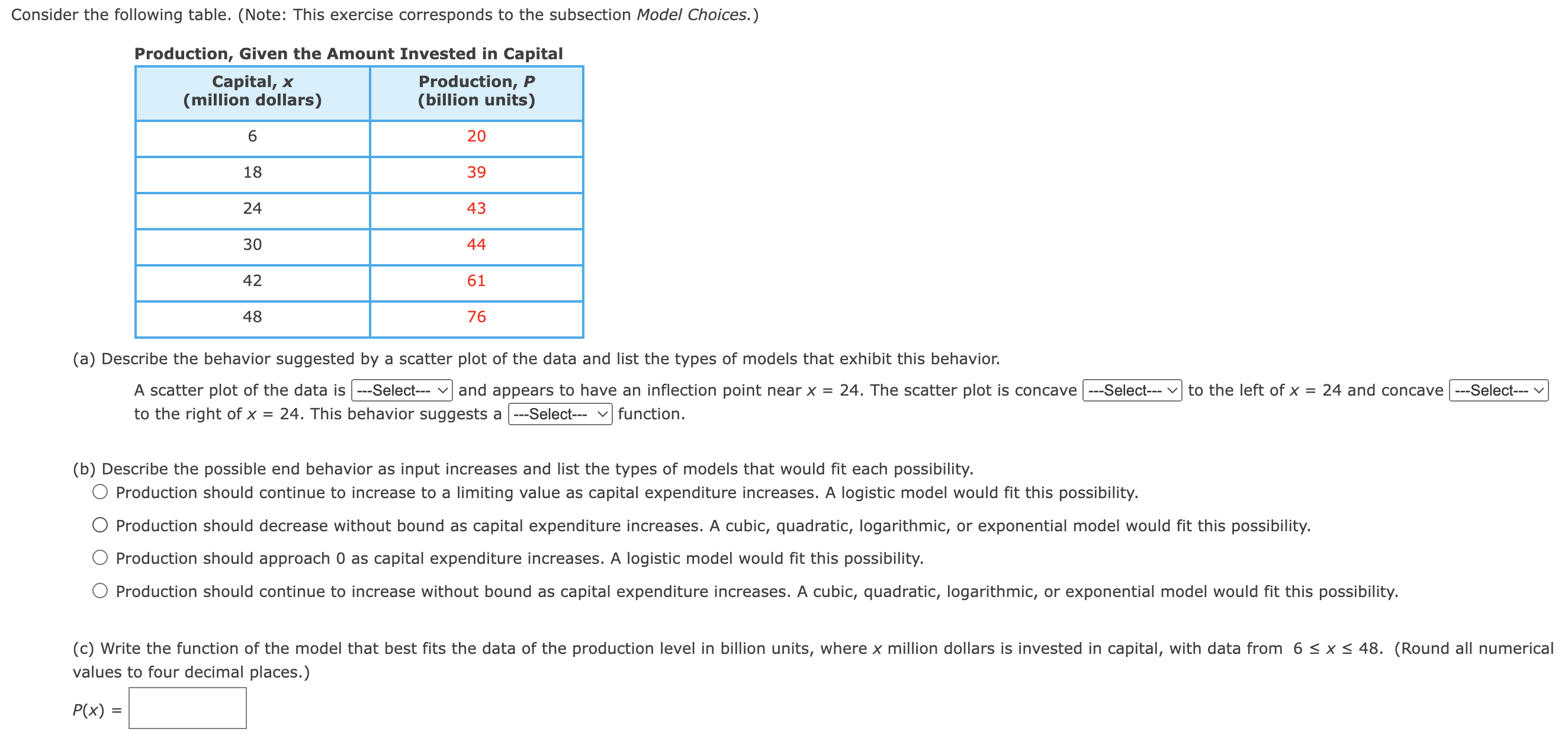
Consider the following table. (Note: This exercise corresponds to the subsection Model Choices.) Production, Given the Amount Invested in Capital Production, P (billion units) Capital, x (million dollars) 6 18 24 30 42 48 20 39 43 44 61 76 (a) Describe the behavior suggested by a scatter plot of the data and list the types of models that exhibit this behavior. A scatter plot of the data is ---Select--- and appears to have an inflection point near x = 24. The scatter plot is concave ---Select--- to the left of x = 24 and concave ---Select--- to the right of x = 24. This behavior suggests a |---Select--- function. (b) Describe the possible end behavior as input increases and list the types of models that would fit each possibility. Production should continue to increase to a limiting value as capital expenditure increases. A logistic model would fit this possibility. O Production should decrease without bound as capital expenditure increases. A cubic, quadratic, logarithmic, or exponential model would fit this possibility. Production should approach 0 as capital expenditure increases. A logistic model would fit this possibility. O Production should continue to increase without bound as capital expenditure increases. A cubic, quadratic, logarithmic, or exponential model would fit this possibility. (c) Write the function of the model that best fits the data of the production level in billion units, where x million dollars is invested in capital, with data from 6 x 48. (Round all numerical values to four decimal places.) P(x) =
Step by Step Solution
There are 3 Steps involved in it

Get step-by-step solutions from verified subject matter experts
 Study Help