







Question: Consider the following time series data. (a) Construct a time series plot. What type of pattern exists in th data? The data appear to follow
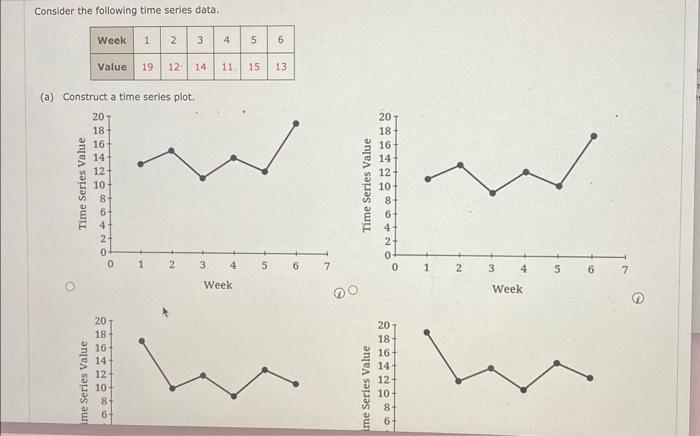
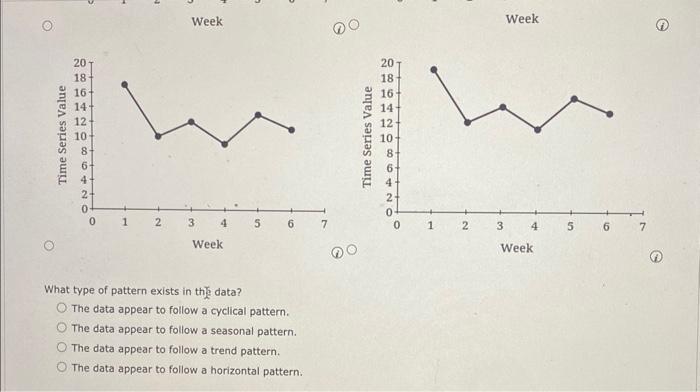
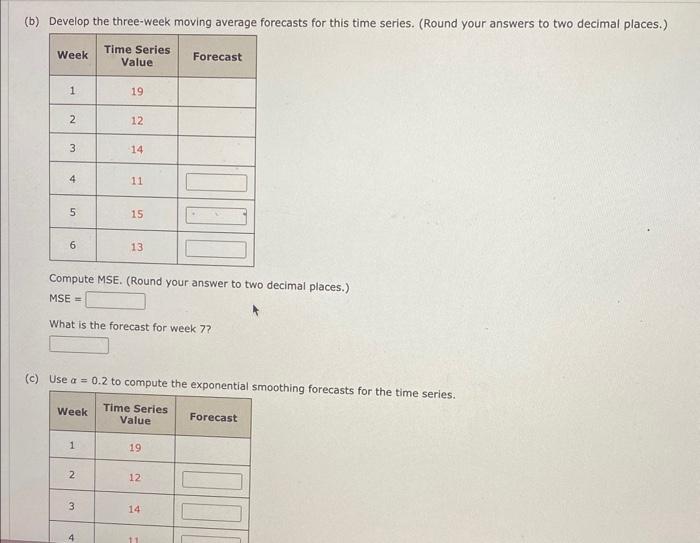
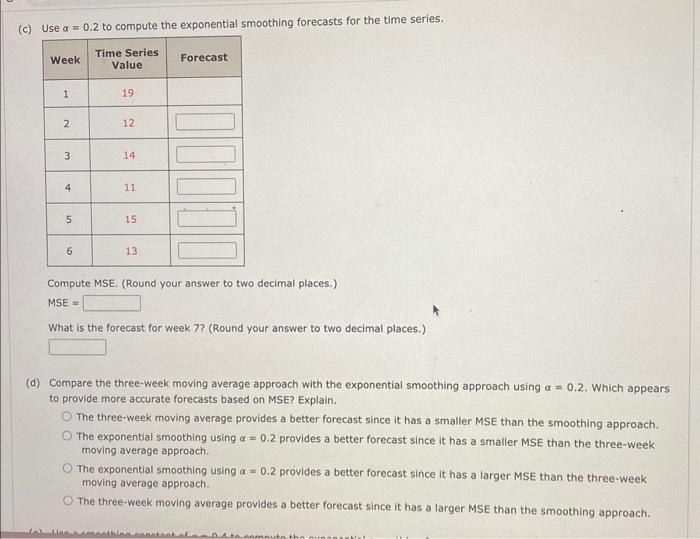
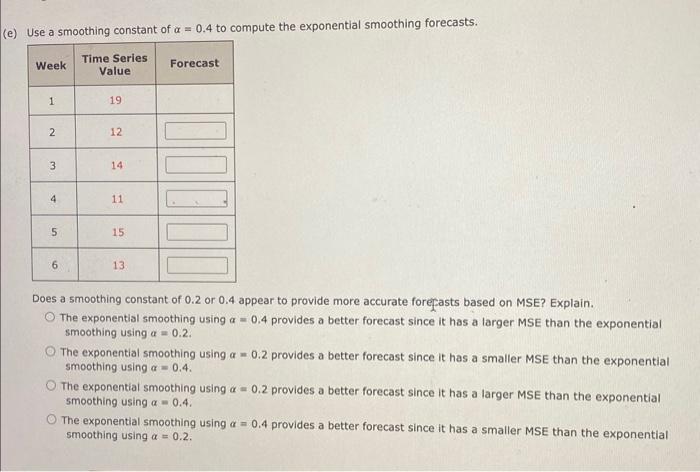
Consider the following time series data. (a) Construct a time series plot. What type of pattern exists in th data? The data appear to follow a cyclical pattern. The data appear to follow a seasonal pattern. The data appear to follow a trend pattern. The data appear to follow a horizontal pattern. (b) Develop the three-week moving average forecasts for this time series. (Round your answers to two decimal places.) Compute MSE. (Round your answer to two decimal places.) MSE= What is the forecast for week 7 ? (c) Use =0.2 to compute the exponential smoothing forecasts for the time series. (c) Use =0.2 to compute the exponential smoothing forecasts for the time series. Compute MSE. (Round your answer to two decimal places.) MSE= What is the forecast for week 7? (Round your answer to two decimal places.) (d) Compare the three-week moving average approach with the exponential smoothing approach using =0.2. Which appears to provide more accurate forecasts based on MSE? Explain. The three-week moving average provides a better forecast since it has a smaller MSE than the smoothing approach. The exponential smoothing using =0.2 provides a better forecast since it has a smaller MSE than the three-week moving average approach. The exponential smoothing using =0.2 provides a better forecast since it has a larger MSE than the three-week moving average approach. The three-week moving average provides a better forecast since it has a larger MSE than the smoothing approach. e) Use a smoothing constant of =0.4 to compute the exponential smoothing forecasts. Does a smoothing constant of 0.2 or 0.4 appear to provide more accurate forejasts based on MSE? Explain. The exponential smoothing using =0.4 provides a better forecast since it has a larger MSE than the exponential smoothing using =0.2. The exponential smoothing using =0.2 provides a better forecast since it has a smaller MSE than the exponential smoothing using =0.4 The exponential smoothing using =0.2 provides a better forecast since it has a larger MSE than the exponential smoothing using =0.4. The exponential smoothing using =0.4 provides a better forecast since it has a smaller MSE than the exponential smoothing using =0.2
Step by Step Solution
There are 3 Steps involved in it

Get step-by-step solutions from verified subject matter experts
 Study Help