







Question: Consider the following transportation network linking node A to node C as shown in Figure Q3: The link travel time functions are the following: Link1:t1=20+x1Link2:t2=10+x2Link3:t3=6+2x3
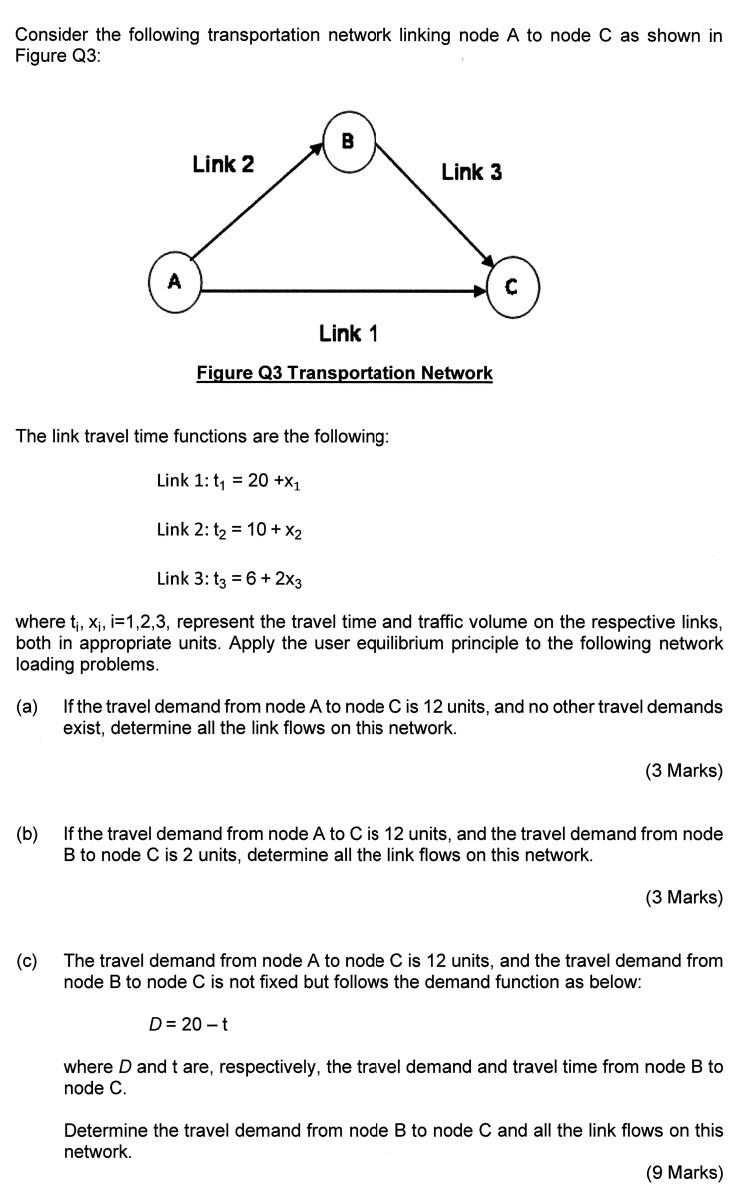
Consider the following transportation network linking node A to node C as shown in Figure Q3: The link travel time functions are the following: Link1:t1=20+x1Link2:t2=10+x2Link3:t3=6+2x3 where ti,xi,i=1,2,3, represent the travel time and traffic volume on the respective links, both in appropriate units. Apply the user equilibrium principle to the following network loading problems. (a) If the travel demand from node A to node C is 12 units, and no other travel demands exist, determine all the link flows on this network. (3 Marks) (b) If the travel demand from node A to C is 12 units, and the travel demand from node B to node C is 2 units, determine all the link flows on this network. (3 Marks) (c) The travel demand from node A to node C is 12 units, and the travel demand from node B to node C is not fixed but follows the demand function as below: D=20t where D and t are, respectively, the travel demand and travel time from node B to node C. Determine the travel demand from node B to node C and all the link flows on this network. (9 Marks) Consider the following transportation network linking node A to node C as shown in Figure Q3: The link travel time functions are the following: Link1:t1=20+x1Link2:t2=10+x2Link3:t3=6+2x3 where ti,xi,i=1,2,3, represent the travel time and traffic volume on the respective links, both in appropriate units. Apply the user equilibrium principle to the following network loading problems. (a) If the travel demand from node A to node C is 12 units, and no other travel demands exist, determine all the link flows on this network. (3 Marks) (b) If the travel demand from node A to C is 12 units, and the travel demand from node B to node C is 2 units, determine all the link flows on this network. (3 Marks) (c) The travel demand from node A to node C is 12 units, and the travel demand from node B to node C is not fixed but follows the demand function as below: D=20t where D and t are, respectively, the travel demand and travel time from node B to node C. Determine the travel demand from node B to node C and all the link flows on this network. (9 Marks)
Step by Step Solution
There are 3 Steps involved in it

Get step-by-step solutions from verified subject matter experts
 Study Help