







Question: Consider the following two 16-bit floating-point representations 1. Format A There is one sign bit There are k = 7 exponent bits. The exponent bias
Consider the following two 16-bit floating-point representations 1. Format A
There is one sign bit There are k = 7 exponent bits. The exponent bias is 63 (0111111)
There are n = 8 fraction/mantissa bits 2. Format B
There is one sign bit
There are k = 8 exponent bits. The exponent bias is 127 (01111111)
There are n = 7 fraction/mantissa bits
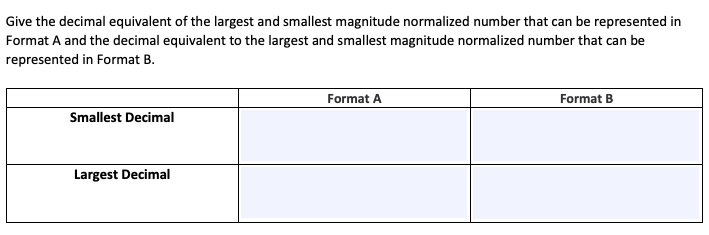
Give the decimal equivalent of the largest and smallest magnitude normalized number that can be represented in Format A and the decimal equivalent to the largest and smallest magnitude normalized number that can be represented in Format B
Give the decimal equivalent of the largest and smallest magnitude normalized number that can be represented in Format A and the decimal equivalent to the largest and smallest magnitude normalized number that can be represented in Format B. Format A Format B Smallest Decimal Largest Decimal
Step by Step Solution
There are 3 Steps involved in it

Get step-by-step solutions from verified subject matter experts
 Study Help