







Question: Consider the following two relations: Sailors(sid: integer, sname: string, rating: integer, age: real), where attribute sid is the primary key of the relation, and Reserves(sid:
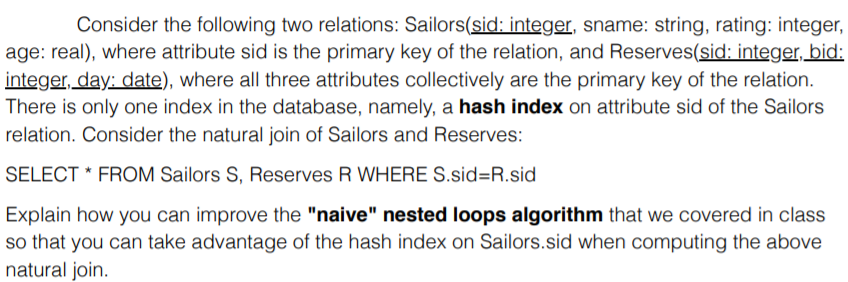
Consider the following two relations: Sailors(sid: integer, sname: string, rating: integer, age: real), where attribute sid is the primary key of the relation, and Reserves(sid: integer,_bid integer,_day: _date), where all three attributes collectively are the primary key of the relation There is only one index in the database, namely, a hash index on attribute sid of the Sailors relation. Consider the natural join of Sailors and Reserves: SELECT FROM Sailors S, Reserves R WHERE S.sid-R.sid Explain how you can improve the "naive" nested loops algorithm that we covered in class so that you can take advantage of the hash index on Sailors.sid when computing the above natural join.
Consider the following two relations: Sailors(sid: integer, sname: string, rating: integer, age: real), where attribute sid is the primary key of the relation, and Reserves(sid: integer,_bid integer,_day: _date), where all three attributes collectively are the primary key of the relation There is only one index in the database, namely, a hash index on attribute sid of the Sailors relation. Consider the natural join of Sailors and Reserves: SELECT FROM Sailors S, Reserves R WHERE S.sid-R.sid Explain how you can improve the "naive" nested loops algorithm that we covered in class so that you can take advantage of the hash index on Sailors.sid when computing the above natural join
Step by Step Solution
There are 3 Steps involved in it

Get step-by-step solutions from verified subject matter experts
 Study Help