







Question: Consider the following two-dimensional partial differential equation in the unit square (x,y)=[0,1][0,1] u(x,y)=x2+y2 with boundary conditions: u(x,0)=0,u(x,1)=x2/2u(0,y)=sin(y),u(1,y)=exsin(y)+y2/2. (a) Prove that the analytical solution to the
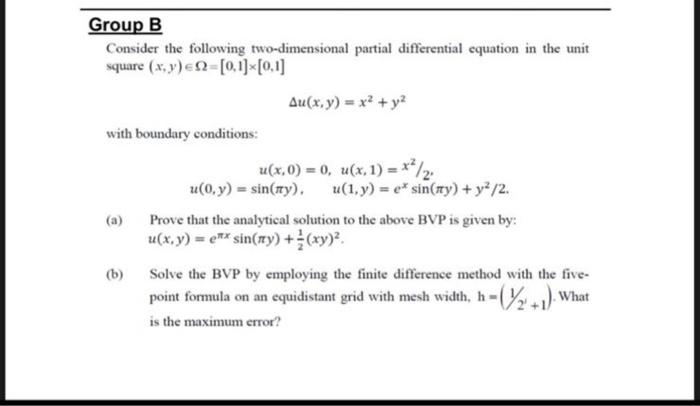
Consider the following two-dimensional partial differential equation in the unit square (x,y)=[0,1][0,1] u(x,y)=x2+y2 with boundary conditions: u(x,0)=0,u(x,1)=x2/2u(0,y)=sin(y),u(1,y)=exsin(y)+y2/2. (a) Prove that the analytical solution to the above BVP is given by: u(x,y)=exsin(y)+21(xy)2 (b) Solve the BVP by employing the finite difference method with the fivepoint formula on an equidistant grid with mesh width, h=(1/2+1). What is the maximum error? Consider the following two-dimensional partial differential equation in the unit square (x,y)=[0,1][0,1] u(x,y)=x2+y2 with boundary conditions: u(x,0)=0,u(x,1)=x2/2u(0,y)=sin(y),u(1,y)=exsin(y)+y2/2. (a) Prove that the analytical solution to the above BVP is given by: u(x,y)=exsin(y)+21(xy)2 (b) Solve the BVP by employing the finite difference method with the fivepoint formula on an equidistant grid with mesh width, h=(1/2+1). What is the maximum error
Step by Step Solution
There are 3 Steps involved in it

Get step-by-step solutions from verified subject matter experts
 Study Help