



Question: Consider the following wffs in the Predicate Calculus: W_1:= (exist x) (exist y) H (x, y), W_2:= (Forall x) (Forall y) (H (x, y) ~
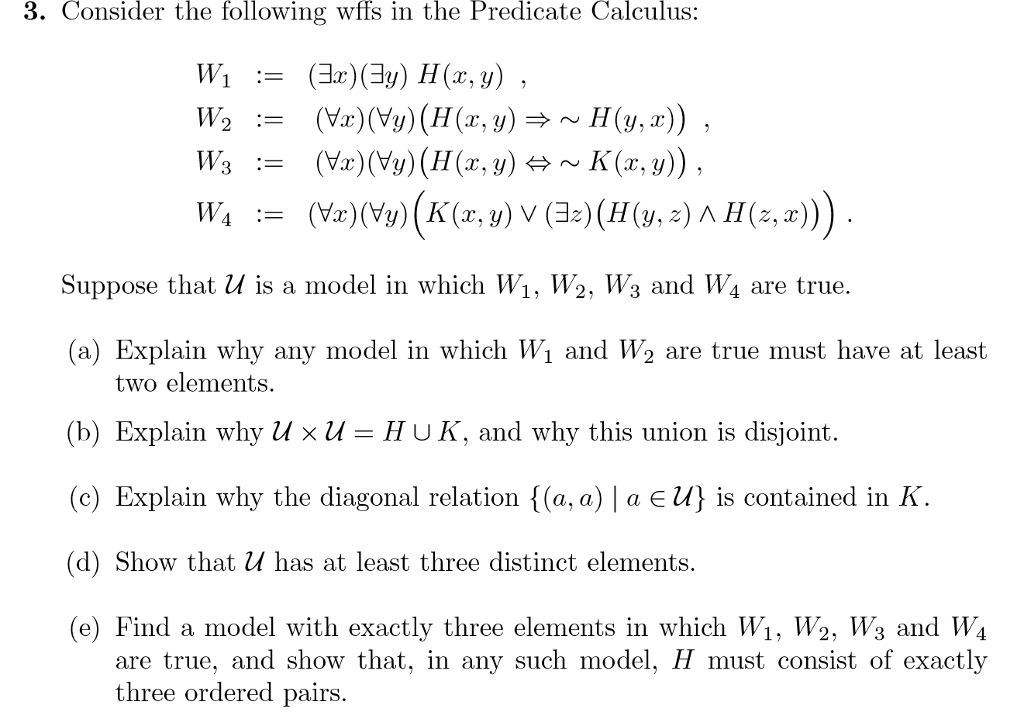
Consider the following wffs in the Predicate Calculus: W_1:= (exist x) (exist y) H (x, y), W_2:= (Forall x) (Forall y) (H (x, y) ~ H(y, x)), W_3:= (Forall x) (Forall y) (H (x, y) ~ K(x, y)), W_4:= (Forall x) (Forall y) (K (x, y) (exist z) (H (y, z) Lambda H(z, x))). Suppose that U is a model in which W_1, W_2, W_3 and W_4 are true. (a) Explain why any model in which W_1 and W_2 are true must have at least two elements. (b) Explain why U times U = H union K, and why this union is disjoint. (c) Explain why the diagonal relation {(a, a) |a elementof U} is contained in K. (d) Show that U has at least three distinct elements. (e) Find a model with exactly three elements in which W_1, W_2, W_3 and W_4 are true, and show that, in any such model, H must consist of exactly three ordered pairs
Step by Step Solution
There are 3 Steps involved in it

Get step-by-step solutions from verified subject matter experts