







Question: Consider the function f (ac) = -2x3 + 39x2 - 240x + 9. For this function there are three important intervals: (-00, A), ( A,
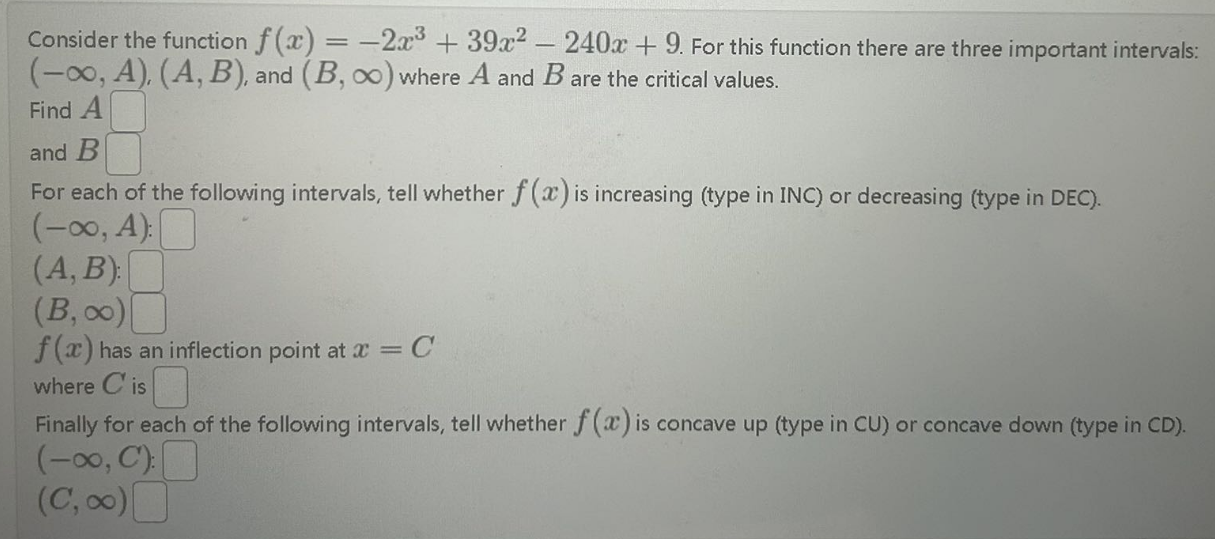
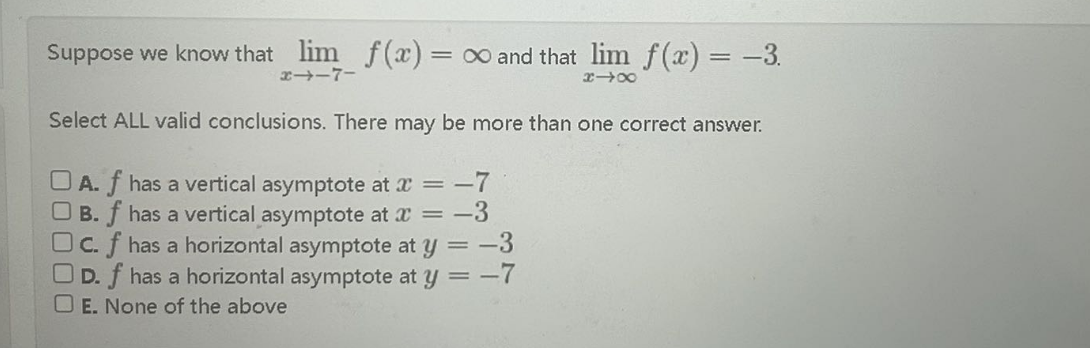
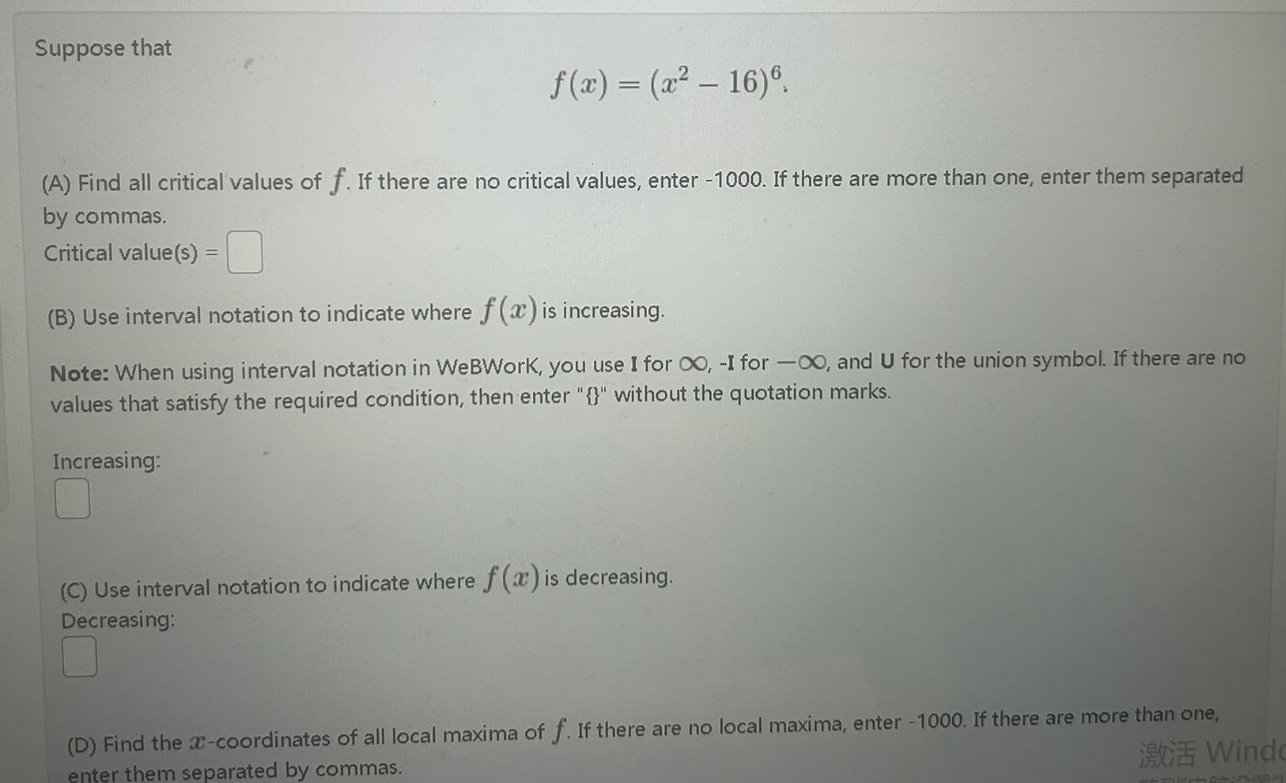
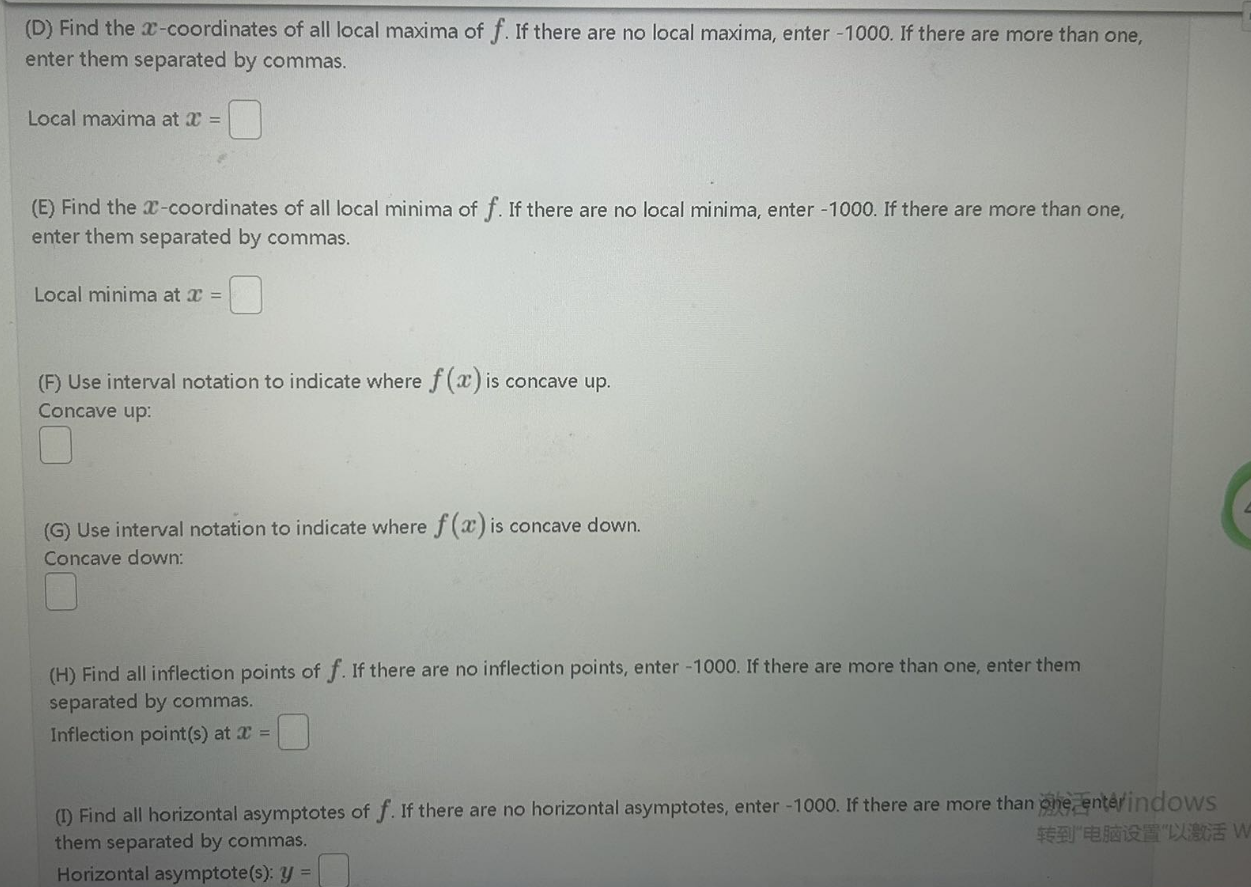
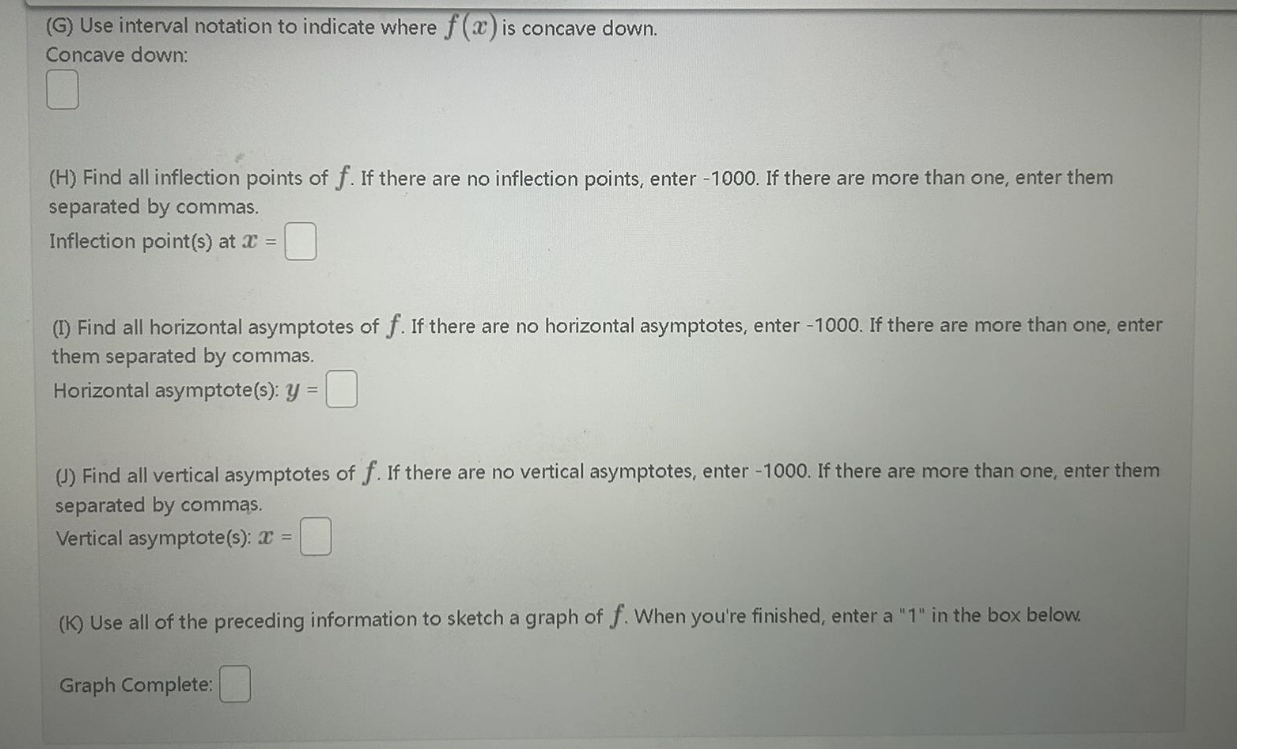
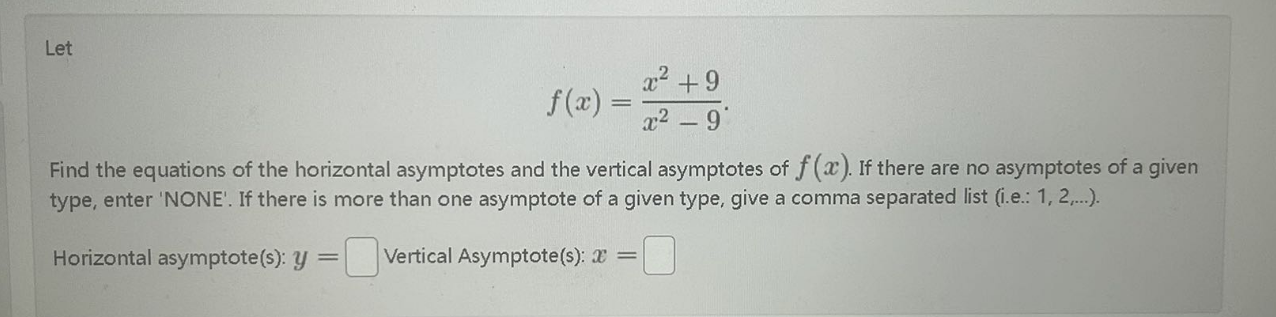
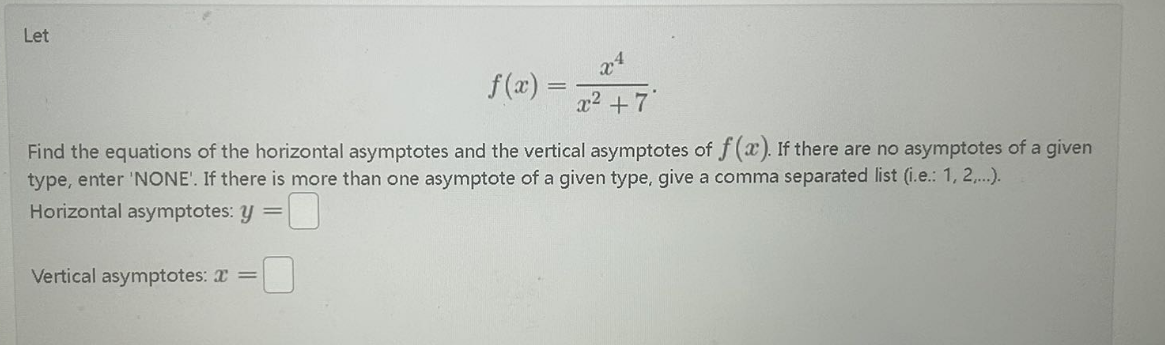
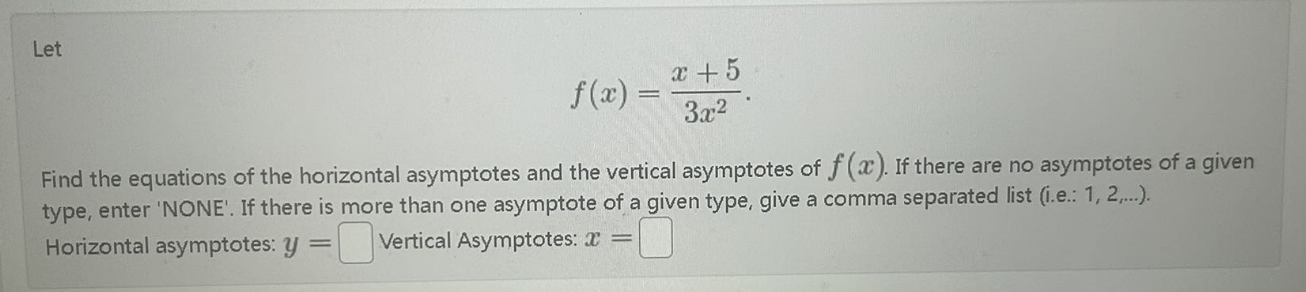
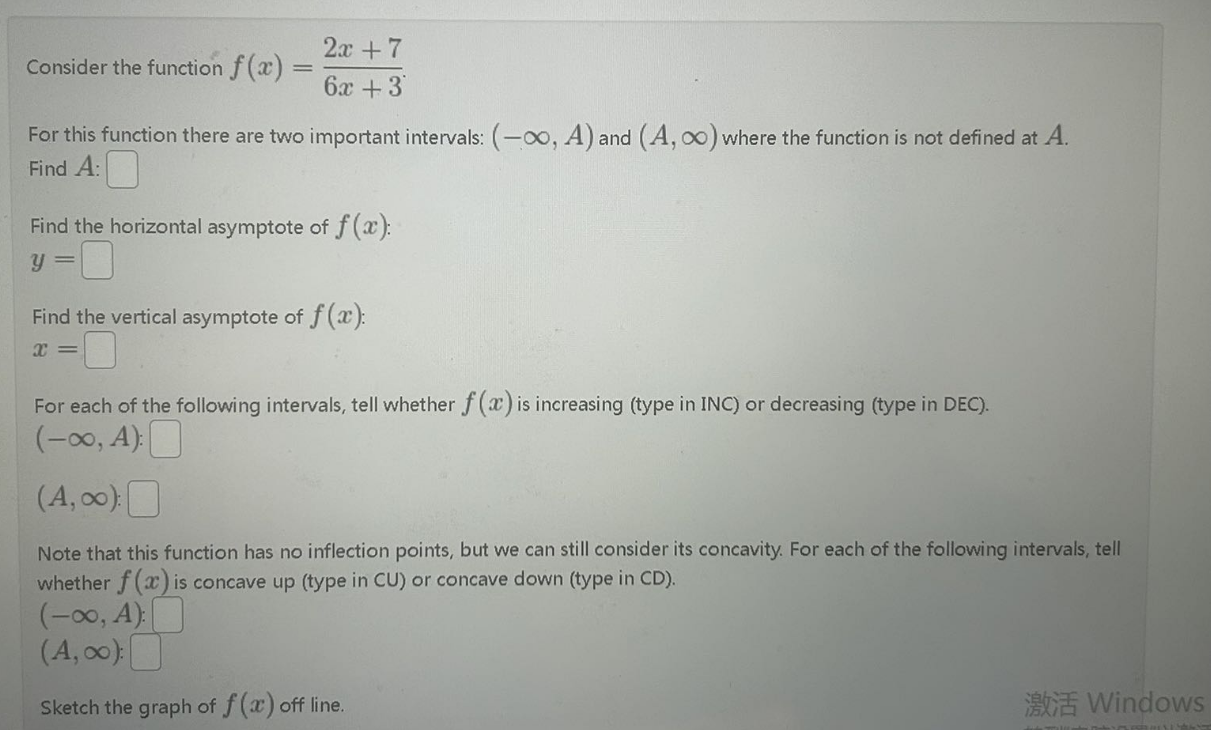
Consider the function f (ac) = -2x3 + 39x2 - 240x + 9. For this function there are three important intervals: (-00, A), ( A, B), and ( B, oo) where A and B are the critical values. Find A and B For each of the following intervals, tell whether f ( ) is increasing (type in INC) or decreasing (type in DEC). (-0o, A): (A, B): (B, 0.) f (a) has an inflection point at a = C' where C is Finally for each of the following intervals, tell whether f (a ) is concave up (type in CU) or concave down (type in CD). (-Oo, C): (C, 00)Suppose we know that lim f(x ) = 0o and that lim f(x) = -3. x-4-7- x-+00 Select ALL valid conclusions. There may be more than one correct answer. O A. f has a vertical asymptote at a O B. f has a vertical asymptote at a = -3 O c. f has a horizontal asymptote at y = -3 O D. f has a horizontal asymptote at y = -7 O E. None of the aboveSuppose that f(x) = (202 - 16)6. (A) Find all critical values of f. If there are no critical values, enter -1000. If there are more than one, enter them separated by commas. Critical value(s) = (B) Use interval notation to indicate where f (a ) is increasing. Note: When using interval notation in WeBWork, you use I for OO, -I for -OO, and U for the union symbol. If there are no values that satisfy the required condition, then enter "{}" without the quotation marks. Increasing: (C) Use interval notation to indicate where f (x ) is decreasing. Decreasing: (D) Find the a-coordinates of all local maxima of f. If there are no local maxima, enter -1000. If there are more than one, enter them separated by commas. iSUE Wind(D) Find the a-coordinates of all local maxima of f. If there are no local maxima, enter -1000. If there are more than one, enter them separated by commas. Local maxima at = (E) Find the -coordinates of all local minima of f. If there are no local minima, enter -1000. If there are more than one, enter them separated by commas. Local minima at @ = (F) Use interval notation to indicate where f (a ) is concave up. Concave up: (G) Use interval notation to indicate where f (a ) is concave down. Concave down: (H) Find all inflection points of f. If there are no inflection points, enter -1000. If there are more than one, enter them separated by commas. Inflection point(s) at a =[ (1) Find all horizontal asymptotes of f. If there are no horizontal asymptotes, enter -1000. If there are more than one, enterindows them separated by commas. Horizontal asymptote (s): y =(G) Use interval notation to indicate where f (@) is concave down. Concave down: (H) Find all inflection points of f. If there are no inflection points, enter -1000. If there are more than one, enter them separated by commas. Inflection point(s) at X = (I) Find all horizontal asymptotes of f. If there are no horizontal asymptotes, enter -1000. If there are more than one, enter them separated by commas. Horizontal asymptote(s): y =[ (J) Find all vertical asymptotes of f. If there are no vertical asymptotes, enter -1000. If there are more than one, enter them separated by commas. Vertical asymptote(s): = (K) Use all of the preceding information to sketch a graph of f. When you're finished, enter a "1" in the box below. Graph Complete:Let f(x) = 202 + 9 2.2 - 9 Find the equations of the horizontal asymptotes and the vertical asymptotes of f (a ). If there are no asymptotes of a given type, enter 'NONE'. If there is more than one asymptote of a given type, give a comma separated list (i.e.: 1, 2,..). Horizontal asymptote(s): y = Vertical Asymptote(s): X =Let 24 f(x) = 2 2 + 7 Find the equations of the horizontal asymptotes and the vertical asymptotes of f (). If there are no asymptotes of a given type, enter 'NONE'. If there is more than one asymptote of a given type, give a comma separated list (i.e.: 1, 2,...). Horizontal asymptotes: y = Vertical asymptotes: ) =Let f(a) = 2 + 5 Find the equations of the horizontal asymptotes and the vertical asymptotes of f (a ). If there are no asymptotes of a given type, enter 'NONE'. If there is more than one asymptote of a given type, give a comma separated list (i.e.: 1, 2,..). Horizontal asymptotes: y = Vertical Asymptotes: X =2x + 7 Consider the function f (a) = 6x + 3 For this function there are two important intervals: (-Oo, A) and ( A, oo ) where the function is not defined at A. Find A: Find the horizontal asymptote of f (a): y = Find the vertical asymptote of f (x): x = For each of the following intervals, tell whether f (a ) is increasing (type in INC) or decreasing (type in DEC). (-00, A): [ (A, 00): [ Note that this function has no inflection points, but we can still consider its concavity. For each of the following intervals, tell whether f (a ) is concave up (type in CU) or concave down (type in CD). (-00, A): (A, 00): Sketch the graph of f (a ) off line. Windows
Step by Step Solution
There are 3 Steps involved in it

Get step-by-step solutions from verified subject matter experts
 Study Help