







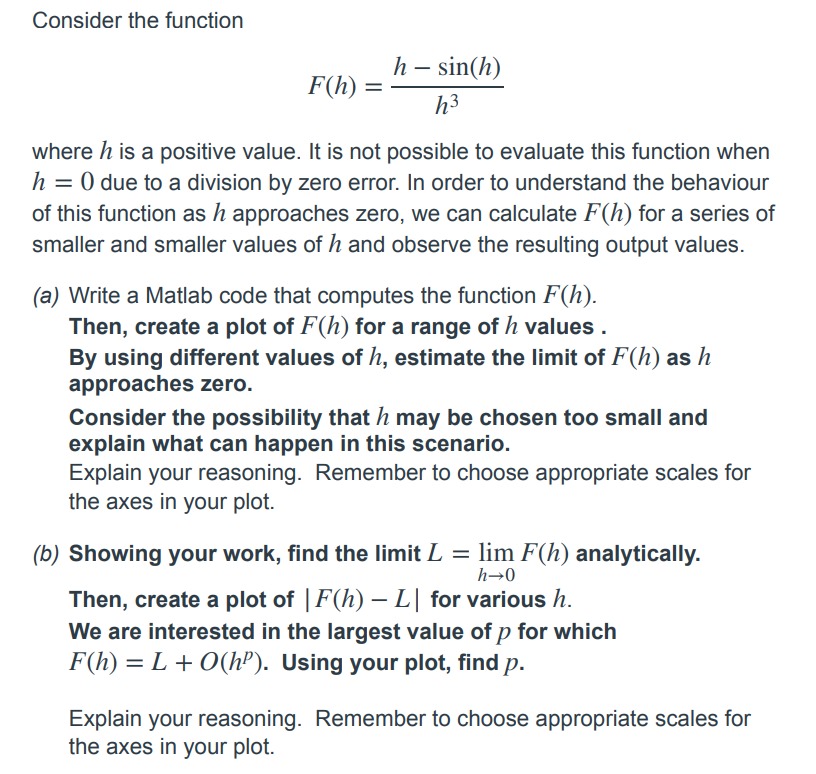
Question: Consider the function F ( h ) = h - s i n ( h ) h 3 where h is a positive value. It
Consider the function
where is a positive value. It is not possible to evaluate this function when
due to a division by zero error. In order to understand the behaviour
of this function as approaches zero, we can calculate for a series of
smaller and smaller values of and observe the resulting output values.
a Write a Matlab code that computes the function
Then, create a plot of for a range of values
By using different values of estimate the limit of as
approaches zero.
Consider the possibility that may be chosen too small and
explain what can happen in this scenario.
Explain your reasoning. Remember to choose appropriate scales for
the axes in your plot.
b Showing your work, find the limit analytically.
Then, create a plot of for various
We are interested in the largest value of for which
Using your plot, find
Explain your reasoning. Remember to choose appropriate scales for
the axes in your plot.Please make a report and do matlab code and post screenshot Your report cannot exceed one page. It should include at least one figure
with proper labels. Make sure to choose axis scales appropriate for the
data. Discussions should be kept brief and answer all questions asked.
Step by Step Solution
There are 3 Steps involved in it
1 Expert Approved Answer
Step: 1 Unlock

Question Has Been Solved by an Expert!
Get step-by-step solutions from verified subject matter experts
Step: 2 Unlock
Step: 3 Unlock
 Study Help