







Question: Consider the function f(A, B, C, D) = sigma m(0, 1 2, 7.8, 9, 10, 15). (a) Write this as a Boolean expression in canonical
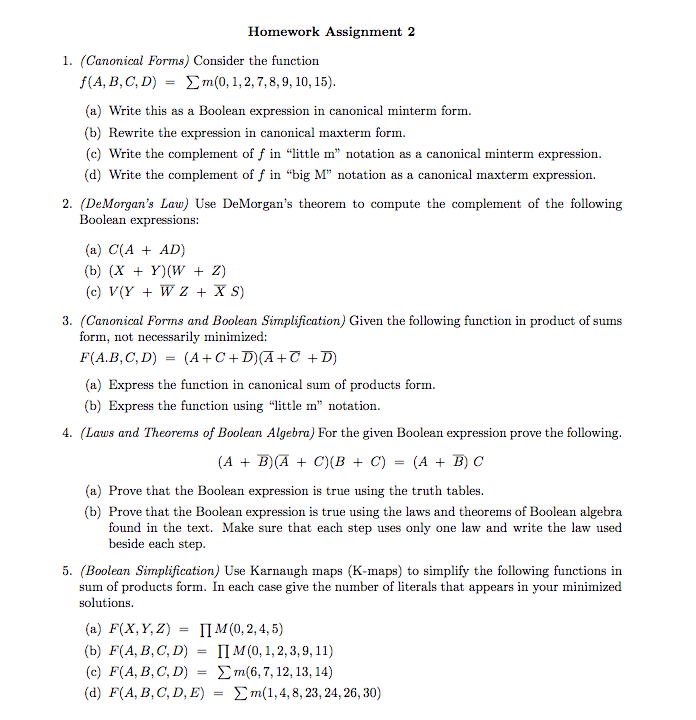
Consider the function f(A, B, C, D) = sigma m(0, 1 2, 7.8, 9, 10, 15). (a) Write this as a Boolean expression in canonical minterm form Rewrite the expression in canonical maxterm form Write the complement of f in "little m notation as a canonical minterm expression. Write the complement of f in "big M" notation as a canonical maxterm expression. (DeMorgan's Law) Use DeMorgan's theorem to compute the complement of the following Boolean expressions: C(A + AD) (X + Y)(W + Z) V(Y + W Z + X S) (Canonical Forms and Boolean Simplification) Given the following function in product of sums form, not necessarily minimized F(A. B, C, D) = (A +C+ D) (A + C + D) Express the function in canonical sum of products form Express the function using "little m notation (Laws and Theorems of Boolean Algebra) For the given Boolean expression prove the following (A + B)(A + C) (B + C) = (A + B) C Prove that the Boolean expression is true using the truth tables Prove that the Boolean expression is true using the laws and theorems of Boolean algebra found in the text. Make sure that each step uses only one law and write the law used beside each step. (Boolean Simplification) Use Karnaugh maps (K-maps to simplify the following functions in sum of products form. In each case give the number of literals that appears in your minimized solutions F(X, Y, Z) = M (0, 2, 4, 5) F(A, B, C, D) = M(0, 1, 2, .3, .9, 11) F(A, B, C, D) = m (6, 7, 13, 14) F(A, B, C, D, E) = m (1, 4, 8, 23, 24, 26, 30)
Step by Step Solution
There are 3 Steps involved in it

Get step-by-step solutions from verified subject matter experts
 Study Help