







Question: Consider the function f(x) = 3 + 4x + 1. The goal is to compute f (x) using the definition f' (z) = lim f(
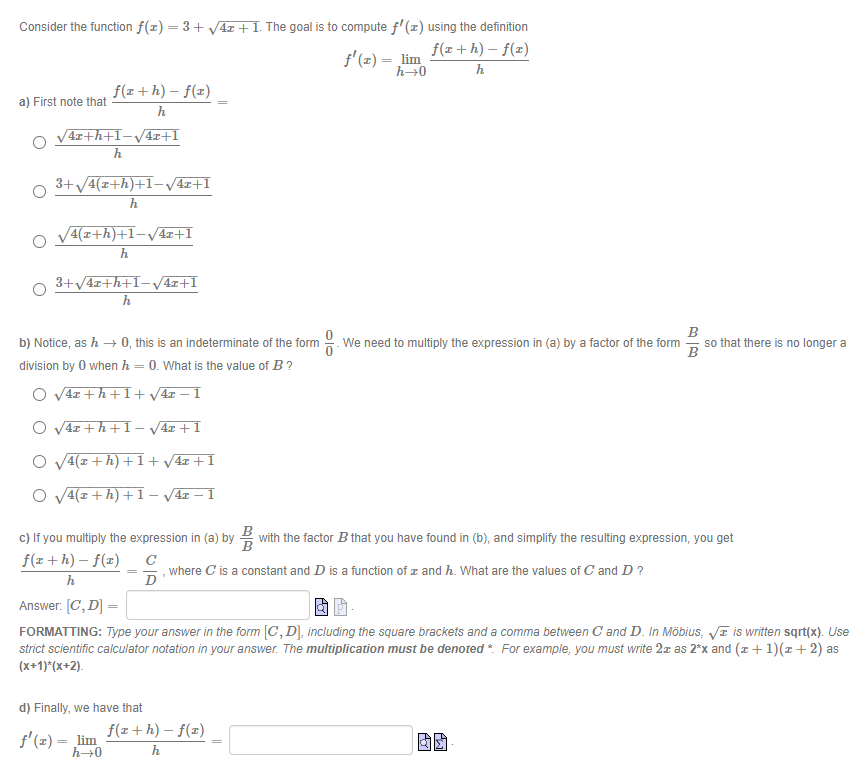
Consider the function f(x) = 3 + 4x + 1. The goal is to compute f (x) using the definition f' (z) = lim f( 0, this is an indeterminate of the form - . We need to multiply the expression in (a) by a factor of the form B so that there is no longer a division by 0 when h = 0. What is the value of B ? O VArth+1+ v4x -1 O VArth+1 - V4x + I O V4(I + h) +1+ v4x +I O V4(I t h) + 1 - V4x -1 c) If you multiply the expression in (a) by with the factor B that you have found in (b), and simplify the resulting expression, you get f( x + h) - f(I) C h , where C is a constant and D is a function of I and h. What are the values of C and D ? Answer: [C, D] = G G. FORMATTING: Type your answer in the form [C, D), including the square brackets and a comma between C and D. In Mobius, , is written sqrt(x). Use strict scientific calculator notation in your answer. The multiplication must be denoted * For example, you must write 2x as 2*x and (x + 1)(x + 2) as (x+1)*(x+2). d) Finally, we have that f'(z) = lim f(It h) - f(I) h-+0
Step by Step Solution
There are 3 Steps involved in it

Get step-by-step solutions from verified subject matter experts
 Study Help