







Question: Consider the hypothesis space shown in Figure 1 (ordered in a lattice using Greaterthanorequalto_g). A Version Space VS is defined by its most general border
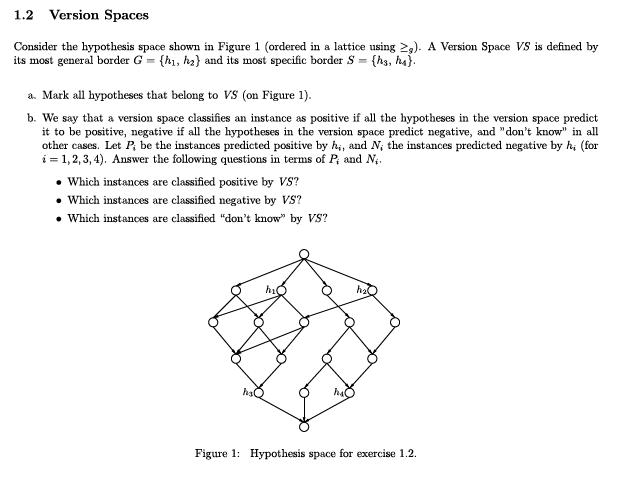
Consider the hypothesis space shown in Figure 1 (ordered in a lattice using Greaterthanorequalto_g). A Version Space VS is defined by its most general border G = {h-1, h_2) and its most specific border S = {h_3, h_4}. a. Mark all hypotheses that belong to VS (on Figure 1). b. We say that a version space classifies an instance as positive if all the hypotheses in the version space predict it to be positive, negative if all the hypotheses in the version space predict negative, and "don't know" in all other cases. Let P_i be the instances predicted positive by h_i, and N_i the instances predicted negative by hi (for i = 1, 2, 3, 4). Answer the following questions in terms of P_i and N_i. Which instances are classified positive by VS? Which instances are classified negative by VS? Which instances are classified "don't know" by VS
Step by Step Solution
There are 3 Steps involved in it

Get step-by-step solutions from verified subject matter experts
 Study Help