Question: Consider the information provided in chapter 11 and in Table 11-2 (Seven Habits of Strong Ethical Leaders) on page 284 of the textbook (Ferrell, Fraedrich,
Consider the information provided in chapter 11 and in Table 11-2 (Seven Habits of Strong Ethical Leaders) on page 284 of the textbook (Ferrell, Fraedrich, & Ferrell, 2019, p. 284), as well as what you have learned about your personal leadership style, and describe the manner in which your leadership practice reflects the following in terms of 1) where you are now, 2) where you desire to be and 3) how you will continue to strive for ethical leadership: Demonstration of ethics as a priority Personal Character Ethical Decision-Making Modeling the ethical values of the organization Positively influencing an ethical culture
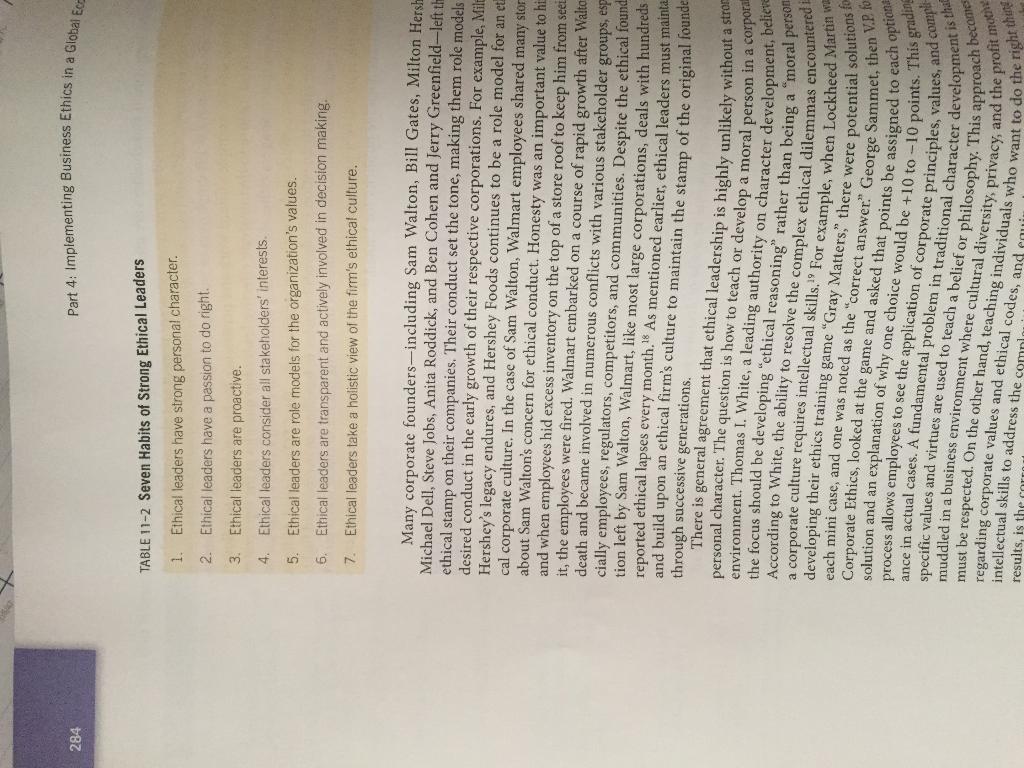
284 Part 4: Implementing Business Ethics in a Global Eur TABLE 11-2 Seven Habits of Strong Ethical Leaders 1. Ethical leaders have strong personal character. 2. Ethical leaders have a passion to do right. 3. Ethical leaders are proactive. 4. Ethical leaders consider all stakeholders' interests 5. Ethical leaders are role models for the organization's values. 6. Ethical leaders are transparent and actively involved in decision making 7. Ethical leaders take a holistic view of the firm's ethical culture. Many corporate founders-including Sam Walton, Bill Gates, Milton Hersh Michael Dell, Steve Jobs, Anita Roddick, and Ben Cohen and Jerry Greenfield-left the ethical stamp on their companies. Their conduct set the tone, making them role models desired conduct in the early growth of their respective corporations. For example, Mile Hershey's legacy endures, and Hershey Foods continues to be a role model for an et cal corporate culture. In the case of Sam Walton, Walmart employees shared many stor about Sam Walton's concern for ethical conduct. Honesty was an important value to hi and when employees hid excess inventory on the top of a store roof to keep him from seei it, the employees were fired. Walmart embarked on a course of rapid growth after Walto death and became involved in numerous conflicts with various stakeholder groups, espa cially employees, regulators, competitors, and communities. Despite the ethical found tion left by Sam Walton, Walmart, like most large corporations, deals with hundreds reported ethical lapses every month. As mentioned earlier, ethical leaders must mainta and build upon ethical firm's culture to maintain the stamp of the original founde through successive generations. There is general agreement that ethical leadership is highly unlikely without a strom personal character. The question is how to teach or develop a moral person in a corporal environment. Thomas I. White, a leading authority on character development, believe a corporate culture requires intellectual skills." For example, when Lockheed Martin. the focus should be developing ethical reasoning rather than being a "moral person According to White, the ability to resolve the complex ethical dilemmas encountered i each mini case, and one was noted as the correct answer. George Sammet, then V.P fo developing their ethics training game "Gray Matters," there were potential solutions fo Corporate Ethics, looked at the game and asked that points be assigned to each options process allows employees to see the application of corporate principles, values, and compl solution and an explanation of why one choice would be +10 to -10 points. This grading ance in actual cases. A fundamental problem in traditional character development is the r philosophy. This approach becomes muddled in a business environment where cultural diversity, privacy, and the profit mathe must be respected. On the other hand, teaching individuals who want to do the right thing specific values and virtues are used to teach a belief or intellectual skills to address the complo regarding corporate values and ethical codes, and rouin results, is the corn









 Study Help