







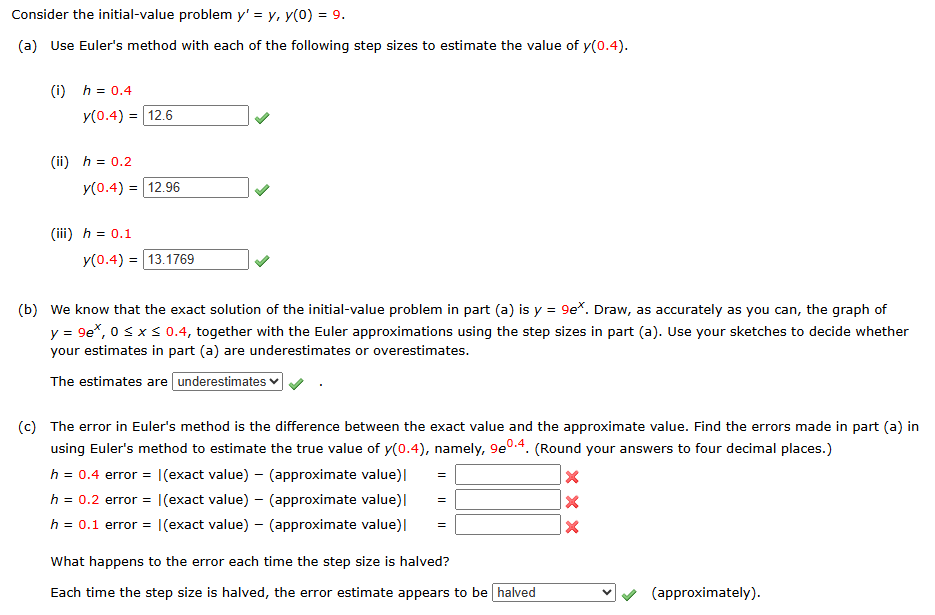
Question: Consider the initial - value problem y ' = y , y ( 0 ) = 9 . ( a ) Use Euler's method with
Consider the initialvalue problem
Use Euler's method with each the following step sizes estimate the value
know that the exact solution the initialvalue problem part Draw, accurately you can, the graph
together with the Euler approximations using the step sizes part Use your sketches decide whether
your estimates part are underestimates overestimates.
The estimates are
The error Euler's method the difference between the exact value and the approximate value. Find the errors made part
using Euler's method estimate the true value namely, your answers four decimal places.
error exact value approximate value
error exact value approximate value
error exact value approximate value
What happens the error each time the step size halved?
Each time the step size halved, the error estimate appears
Step by Step Solution
There are 3 Steps involved in it
1 Expert Approved Answer
Step: 1 Unlock

Question Has Been Solved by an Expert!
Get step-by-step solutions from verified subject matter experts
Step: 2 Unlock
Step: 3 Unlock
 Study Help