







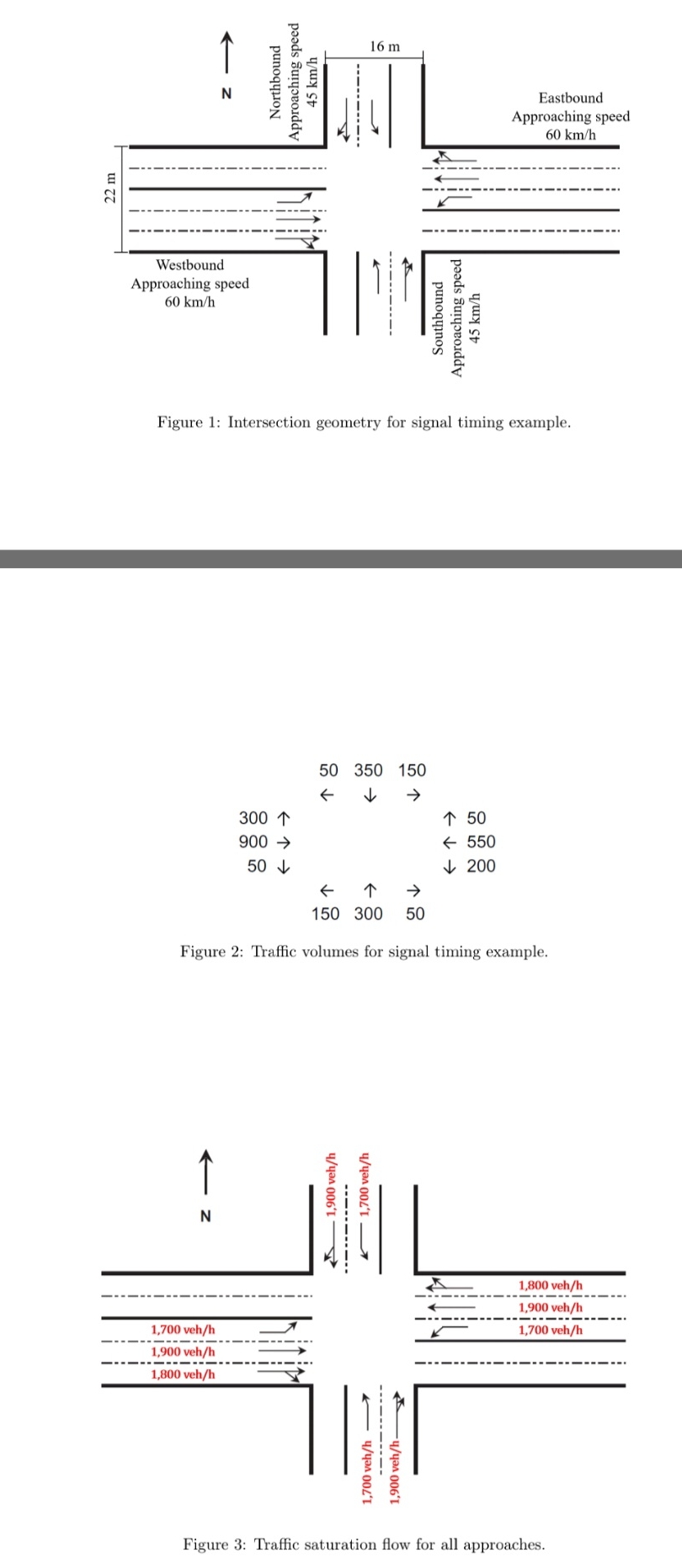
Question: Consider the intersection shown in Figure 1 . This intersection consists of four - legged intersection with specific dimensions and traffic characteristics. Each approach has
Consider the intersection shown in Figure This intersection consists of fourlegged intersection with specific dimensions and traffic characteristics. Each approach has multiple lanes marked with distinct line types. For example, the solid lines identify the road boundaries where the dashed lines represents the lanes for each approach. The arrows represents the traffic directions for each approach, and Figure identify the amount of the traffic flow for each direction. Figure illustrates the saturation traffic flow for each approach. For the Eastbound and Westbound, assume of the traffic flow going through the intersection split for through across exclusiveshared lanes.
The tasks that are required to determine the traffic signal timing are as follows:
Identify leftturn treatments.
Identify lane groups for each approach.
Determine lane group traffic data.
Develop the desired phasing plan.
Calculate required yellow and allRed times
Determine lost time per phase and per cycle.
Estimate the cycle length.
Calculate total effective green time available per cycle.
Distribute effective green times across all phases.
Calculate actual green time per phase.
Figure : Intersection geometry for signal timing example.
Figure : Traffic volumes for signal timing example.
Step by Step Solution
There are 3 Steps involved in it
1 Expert Approved Answer
Step: 1 Unlock

Question Has Been Solved by an Expert!
Get step-by-step solutions from verified subject matter experts
Step: 2 Unlock
Step: 3 Unlock
 Study Help