







Question: Consider the iterative improvement algorithm Solve Az = b for initial approximation ro. fori-0, 1,... until convergence compute ri = b-Aki solve Azi = ri
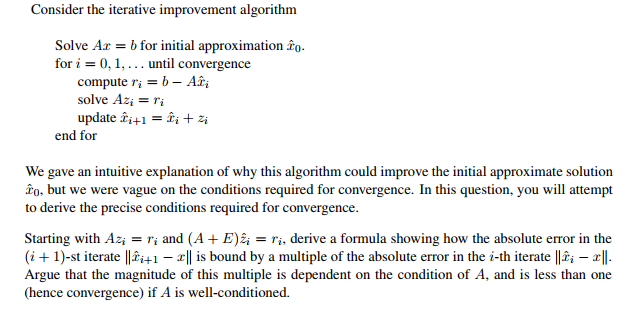
Consider the iterative improvement algorithm Solve Az = b for initial approximation ro. fori-0, 1,... until convergence compute ri = b-Aki solve Azi = ri update ii+1 = xi + zi end for We gave an inuitive nonf why this algorthm could imrove the initial approximate solution to, but we were vague on the conditions required for convergence. In this question, you will attempt to derive the precise conditions required for convergence Starting with Azri and (A E)ri, derive a formula showing how the absolute error in the (i + 1)-st iterate llriH- is bound by a multiple of the absolute error in the i-th iterate Ili,- Argue that the magnitude of this multiple is dependent on the condition of A, and is less than one (hence convergence) if A is well-conditioned. Consider the iterative improvement algorithm Solve Az = b for initial approximation ro. fori-0, 1,... until convergence compute ri = b-Aki solve Azi = ri update ii+1 = xi + zi end for We gave an inuitive nonf why this algorthm could imrove the initial approximate solution to, but we were vague on the conditions required for convergence. In this question, you will attempt to derive the precise conditions required for convergence Starting with Azri and (A E)ri, derive a formula showing how the absolute error in the (i + 1)-st iterate llriH- is bound by a multiple of the absolute error in the i-th iterate Ili,- Argue that the magnitude of this multiple is dependent on the condition of A, and is less than one (hence convergence) if A is well-conditioned
Step by Step Solution
There are 3 Steps involved in it

Get step-by-step solutions from verified subject matter experts
 Study Help