



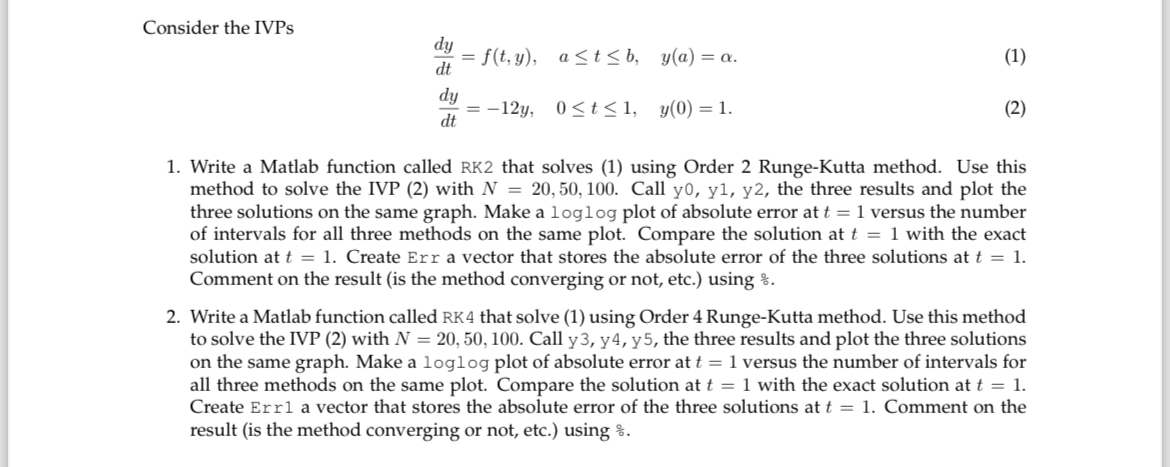
Question: Consider the IVPs d y d t = f ( t , y ) , a t b , y ( a ) = d
Consider the IVPs
Write a Matlab function called RK that solves using Order RungeKutta method. Use this method to solve the IVP with Call y y y the three results and plot the three solutions on the same graph. Make a plot of absolute error at versus the number of intervals for all three methods on the same plot. Compare the solution at with the exact solution at Create Err a vector that stores the absolute error of the three solutions at Comment on the result is the method converging or not, etc. using
Write a Matlab function called RK that solve using Order RungeKutta method. Use this method to solve the IVP with Call y the three results and plot the three solutions on the same graph. Make a plot of absolute error at versus the number of intervals for all three methods on the same plot. Compare the solution at with the exact solution at Create Err a vector that stores the absolute error of the three solutions at Comment on the result is the method converging or not, etc. using
Step by Step Solution
There are 3 Steps involved in it
1 Expert Approved Answer
Step: 1 Unlock

Question Has Been Solved by an Expert!
Get step-by-step solutions from verified subject matter experts
Step: 2 Unlock
Step: 3 Unlock