







Question: Consider the key work values in Table 5.1. Recalling that leaders are motivated to act consistently with their values, what values appear to be most
Consider the key work values in Table 5.1. Recalling that leaders are motivated to act consistently with their values, what values appear to be most important to Gary Erickson?
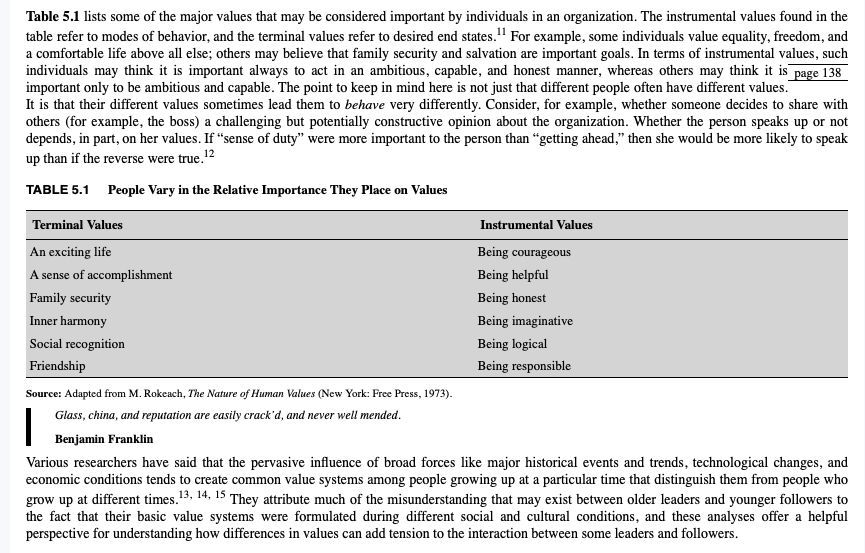
Table 5.1 lists some of the major values that may be considered important by individuals in an organization. The instrumental values found in the table refer to modes of behavior, and the terminal values refer to desired end states. 11 For example, some individuals value equality, freedom, and a comfortable life above all else; others may believe that family security and salvation are important goals. In terms of instrumental values, such individuals may think it is important always to act in an ambitious, capable, and honest manner, whereas others may think it is page 138 important only to be ambitious and capable. The point to keep in mind here is not just that different people often have different values. It is that their different values sometimes lead them to behave very differently. Consider, for example, whether someone decides to share with others (for example, the boss) a challenging but potentially constructive opinion about the organization. Whether the person speaks up or not depends, in part, on her values. If "sense of duty" were more important to the person than "getting ahead," then she would be more likely to speak up than if the reverse were true. 12 TABLE 5.1 People Vary in the Relative Importance They Place on Values Source: Adapted from M. Rokeach, The Nature of Human Values (New York: Free Press, 1973). Glass, china, and reputation are easily crack'd, and never well mended. Benjamin Franklin Various researchers have said that the pervasive influence of broad forces like major historical events and trends, technological changes, and economic conditions tends to create common value systems among people growing up at a particular time that distinguish them from people who grow up at different times. 13,14,15 They attribute much of the misunderstanding that may exist between older leaders and younger followers to the fact that their basic value systems were formulated during different social and cultural conditions, and these analyses offer a helpful perspective for understanding how differences in values can add tension to the interaction between some leaders and followers. Table 5.1 lists some of the major values that may be considered important by individuals in an organization. The instrumental values found in the table refer to modes of behavior, and the terminal values refer to desired end states. 11 For example, some individuals value equality, freedom, and a comfortable life above all else; others may believe that family security and salvation are important goals. In terms of instrumental values, such individuals may think it is important always to act in an ambitious, capable, and honest manner, whereas others may think it is page 138 important only to be ambitious and capable. The point to keep in mind here is not just that different people often have different values. It is that their different values sometimes lead them to behave very differently. Consider, for example, whether someone decides to share with others (for example, the boss) a challenging but potentially constructive opinion about the organization. Whether the person speaks up or not depends, in part, on her values. If "sense of duty" were more important to the person than "getting ahead," then she would be more likely to speak up than if the reverse were true. 12 TABLE 5.1 People Vary in the Relative Importance They Place on Values Source: Adapted from M. Rokeach, The Nature of Human Values (New York: Free Press, 1973). Glass, china, and reputation are easily crack'd, and never well mended. Benjamin Franklin Various researchers have said that the pervasive influence of broad forces like major historical events and trends, technological changes, and economic conditions tends to create common value systems among people growing up at a particular time that distinguish them from people who grow up at different times. 13,14,15 They attribute much of the misunderstanding that may exist between older leaders and younger followers to the fact that their basic value systems were formulated during different social and cultural conditions, and these analyses offer a helpful perspective for understanding how differences in values can add tension to the interaction between some leaders and followers
Step by Step Solution
There are 3 Steps involved in it

Get step-by-step solutions from verified subject matter experts
 Study Help