







Question: Consider the language L = {w Element {a, b, c}* | w ends with an alpha} (a) What is L*? Briefly justify your answer. (b)
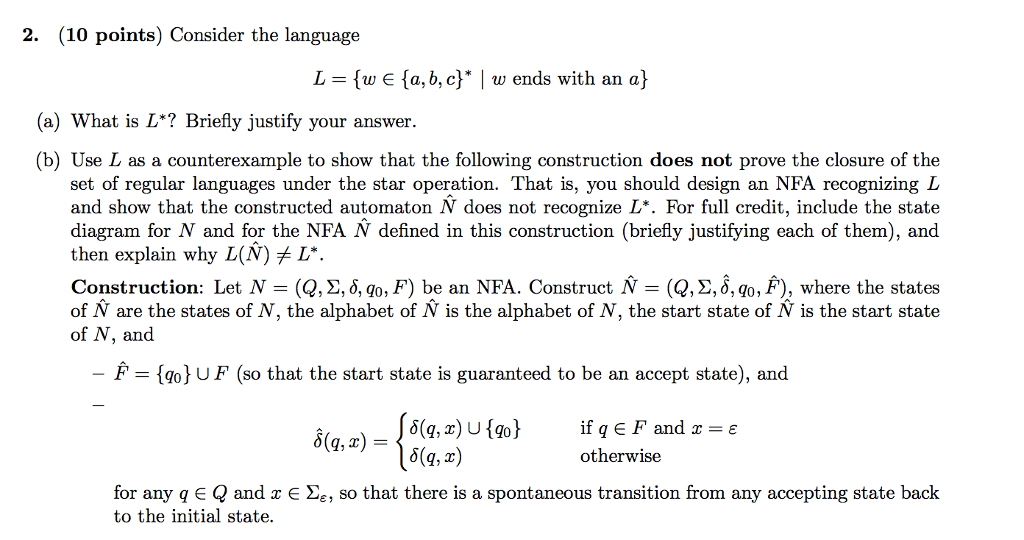
Consider the language L = {w Element {a, b, c}* | w ends with an alpha} (a) What is L*? Briefly justify your answer. (b) Use L as a counterexample to show that the following construction does not prove the closure of the set of regular languages under the star operation. That is, you should design an NFA recognizing L and show that the constructed automaton N does not recognize L*. For full credit, include the state diagram for N and for the NFA N defined in this construction (briefly justifying each of them), and then explain why L (N) notequalto L*. Construction: Let N = (Q, sigma, delta, q_0, F) be an NFA. Construct N = (Q, sigma, delta, q_0, F), where the states of N are the states of N, the alphabet of N is the alphabet of N, the start state of N is the start state of N, and - F = {q_0} Union F (so that the start state is guaranteed to be an accept state), and delta (q, x) = {delta (q, x) Union {q_0} if q Element F and x = epsilon delta (q, x) otherwise for any q Element Q and x Element sigma_epsilon, so that there is a spontaneous transition from any accepting state back to the initial state. Consider the language L = {w Element {a, b, c}* | w ends with an alpha} (a) What is L*? Briefly justify your answer. (b) Use L as a counterexample to show that the following construction does not prove the closure of the set of regular languages under the star operation. That is, you should design an NFA recognizing L and show that the constructed automaton N does not recognize L*. For full credit, include the state diagram for N and for the NFA N defined in this construction (briefly justifying each of them), and then explain why L (N) notequalto L*. Construction: Let N = (Q, sigma, delta, q_0, F) be an NFA. Construct N = (Q, sigma, delta, q_0, F), where the states of N are the states of N, the alphabet of N is the alphabet of N, the start state of N is the start state of N, and - F = {q_0} Union F (so that the start state is guaranteed to be an accept state), and delta (q, x) = {delta (q, x) Union {q_0} if q Element F and x = epsilon delta (q, x) otherwise for any q Element Q and x Element sigma_epsilon, so that there is a spontaneous transition from any accepting state back to the initial state
Step by Step Solution
There are 3 Steps involved in it

Get step-by-step solutions from verified subject matter experts
 Study Help