





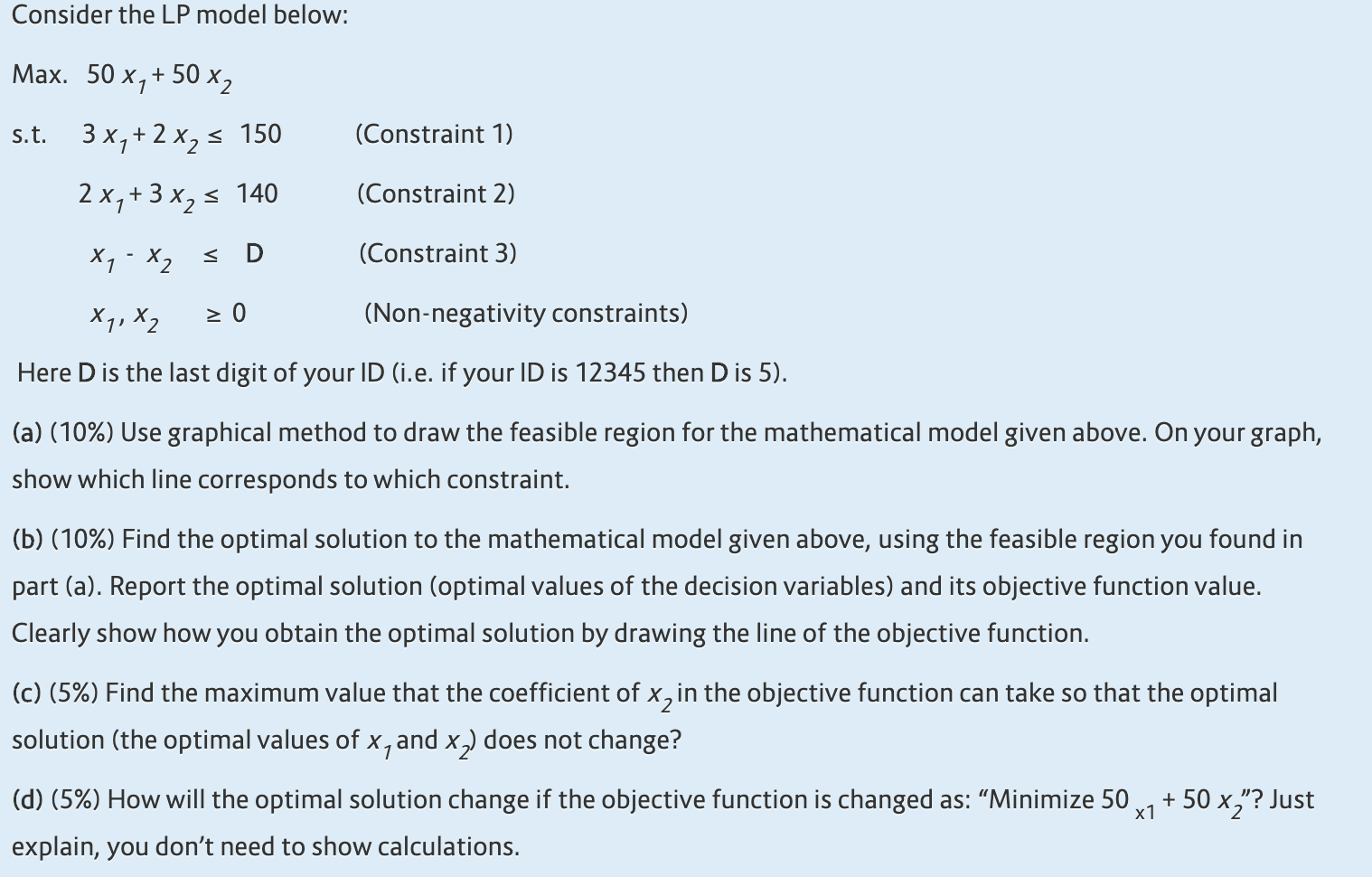
Question: Consider the LP model below: Max. 50 x,+ 50 x2 s.t. (Constraint 1) 3x,+ 2 xz s 150 2 x,+3 xz s 140 (Constraint 2)
Consider the LP model below: Max. 50 x,+ 50 x2

Consider the LP model below: Max. 50 x,+ 50 x2 s.t. (Constraint 1) 3x,+ 2 xz s 150 2 x,+3 xz s 140 (Constraint 2) Xy - X2 s D (Constraint 3) 1, 2 20 (Non-negativity constraints) Here D is the last digit of your ID (i.e. if your ID is 12345 then D is 5). (a) (10%) Use graphical method to draw the feasible region for the mathematical model given above. On your graph, show which line corresponds to which constraint. (b) (10%) Find the optimal solution to the mathematical model given above, using the feasible region you found in part (a). Report the optimal solution (optimal values of the decision variables) and its objective function value. Clearly show how you obtain the optimal solution by drawing the line of the objective function. (c) (5%) Find the maximum value that the coefficient of xz in the objective function can take so that the optimal solution (the optimal values of xy and x) does not change? (d) (5%) How will the optimal solution change if the objective function is changed as: Minimize 50 + 50 x"? Just explain, you don't need to show calculations. x1 Consider the LP model below: Max. 50 x,+ 50 x2 s.t. (Constraint 1) 3x,+ 2 xz s 150 2 x,+3 xz s 140 (Constraint 2) Xy - X2 s D (Constraint 3) 1, 2 20 (Non-negativity constraints) Here D is the last digit of your ID (i.e. if your ID is 12345 then D is 5). (a) (10%) Use graphical method to draw the feasible region for the mathematical model given above. On your graph, show which line corresponds to which constraint. (b) (10%) Find the optimal solution to the mathematical model given above, using the feasible region you found in part (a). Report the optimal solution (optimal values of the decision variables) and its objective function value. Clearly show how you obtain the optimal solution by drawing the line of the objective function. (c) (5%) Find the maximum value that the coefficient of xz in the objective function can take so that the optimal solution (the optimal values of xy and x) does not change? (d) (5%) How will the optimal solution change if the objective function is changed as: Minimize 50 + 50 x"? Just explain, you don't need to show calculations. x1

Step by Step Solution

There are 3 Steps involved in it

1 Expert Approved Answer
Step: 1 Unlock blur-text-image

Question Has Been Solved by an Expert!

Get step-by-step solutions from verified subject matter experts

Step: 2 Unlock
Step: 3 Unlock

Students Have Also Explored These Related General Management Questions!