



Question: Consider the Malthusian model where Y t = S ( A t L t ) 1 - , A t + 1 = ( 1
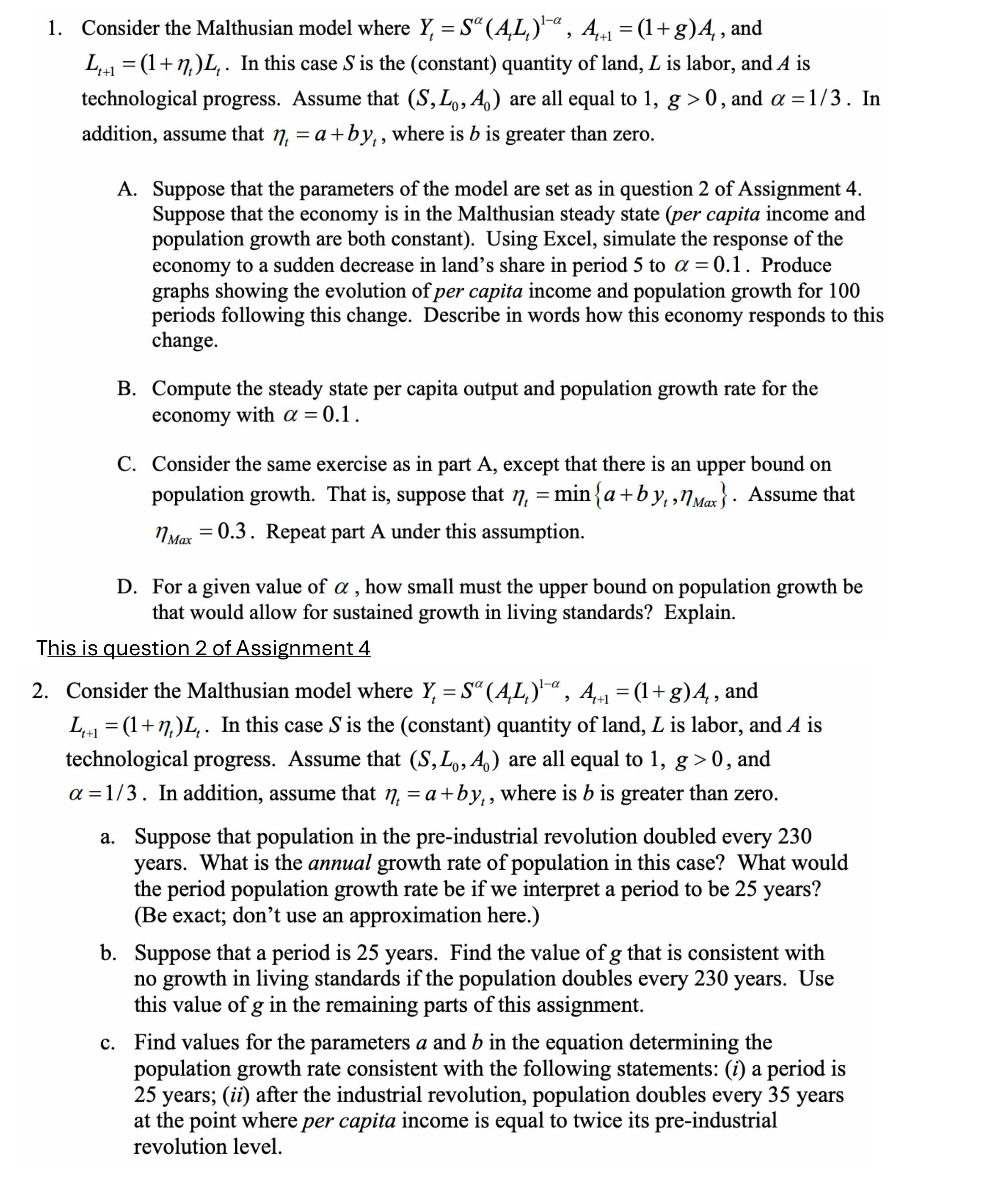
Consider the Malthusian model where and In this case is the constant quantity of land, is labor, and is technological progress. Assume that are all equal to and In addition, assume that where is is greater than zero.
A Suppose that the parameters of the model are set as in question of Assignment Suppose that the economy is in the Malthusian steady state per capita income and population growth are both constant Using Excel, simulate the response of the economy to a sudden decrease in land's share in period to Produce graphs showing the evolution of per capita income and population growth for periods following this change. Describe in words how this economy responds to this change.
B Compute the steady state per capita output and population growth rate for the economy with
C Consider the same exercise as in part A except that there is an upper bound on population growth. That is suppose that min Assume that Repeat part A under this assumption.
D For a given value of how small must the upper bound on population growth be that would allow for sustained growth in living standards? Explain.
This is question of Assignment
Consider the Malthusian model where and In this case is the constant quantity of land, is labor, and is technological progress. Assume that are all equal to and In addition, assume that where is is greater than zero.
a Suppose that population in the preindustrial revolution doubled every years. What is the annual growth rate of population in this case? What would the period population growth rate be if we interpret a period to be years? Be exact; don't use an approximation here.
b Suppose that a period is years. Find the value of that is consistent with no growth in living standards if the population doubles every years. Use this value of in the remaining parts of this assignment.
c Find values for the parameters a and in the equation determining the population growth rate consistent with the following statements: i a period is years; ii after the industrial revolution, population doubles every years at the point where per capita income is equal to twice its preindustrial revolution level.
Step by Step Solution
There are 3 Steps involved in it
1 Expert Approved Answer
Step: 1 Unlock

Question Has Been Solved by an Expert!
Get step-by-step solutions from verified subject matter experts
Step: 2 Unlock
Step: 3 Unlock