







Question: Consider the Mincer model covered in class, which produced the following relationship between wage earnings Wt, years of schooling st and work experience at Pok
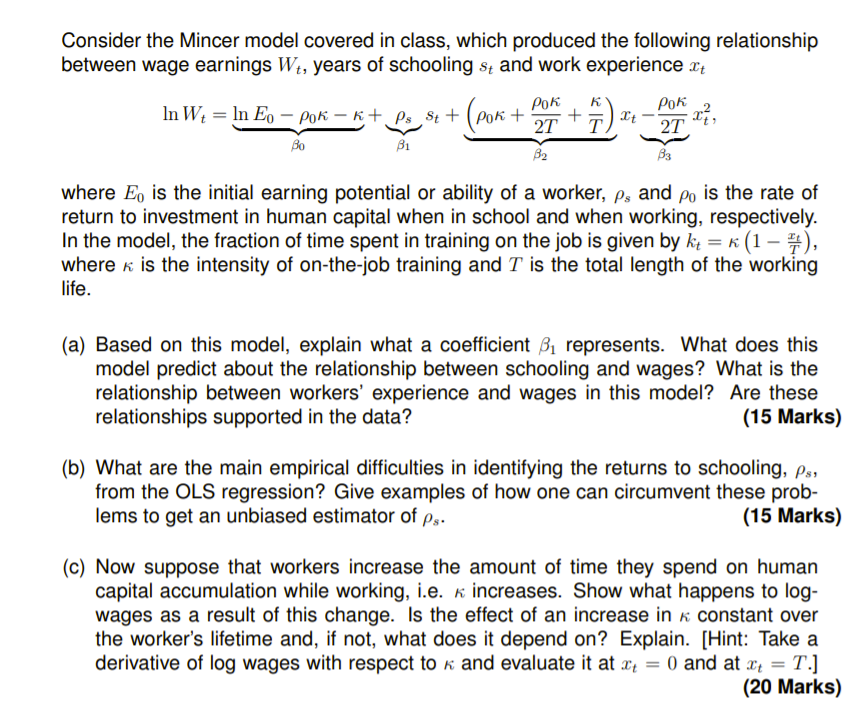
Consider the Mincer model covered in class, which produced the following relationship between wage earnings Wt, years of schooling st and work experience at Pok In W = ln Eo - Pok - K + Ps, St + (pok + + 2T Bo B1 B2 - x7, 2T B3 where E, is the initial earning potential or ability of a worker, Ps and po is the rate of return to investment in human capital when in school and when working, respectively. In the model, the fraction of time spent in training on the job is given by kt = (1 ), where k is the intensity of on-the-job training and T is the total length of the working life. (a) Based on this model, explain what a coefficient B, represents. What does this model predict about the relationship between schooling and wages? What is the relationship between workers' experience and wages in this model? Are these relationships supported in the data? (15 Marks) (b) What are the main empirical difficulties in identifying the returns to schooling, Ps, from the OLS regression? Give examples of how one can circumvent these prob- lems to get an unbiased estimator of Ps. (15 Marks) (c) Now suppose that workers increase the amount of time they spend on human capital accumulation while working, i.e. k increases. Show what happens to log- wages as a result of this change. Is the effect of an increase in k constant over the worker's lifetime and, if not, what does it depend on? Explain. [Hint: Take a derivative of log wages with respect to k and evaluate it at x t = 0 and at xt = T.] (20 Marks) Consider the Mincer model covered in class, which produced the following relationship between wage earnings Wt, years of schooling st and work experience at Pok In W = ln Eo - Pok - K + Ps, St + (pok + + 2T Bo B1 B2 - x7, 2T B3 where E, is the initial earning potential or ability of a worker, Ps and po is the rate of return to investment in human capital when in school and when working, respectively. In the model, the fraction of time spent in training on the job is given by kt = (1 ), where k is the intensity of on-the-job training and T is the total length of the working life. (a) Based on this model, explain what a coefficient B, represents. What does this model predict about the relationship between schooling and wages? What is the relationship between workers' experience and wages in this model? Are these relationships supported in the data? (15 Marks) (b) What are the main empirical difficulties in identifying the returns to schooling, Ps, from the OLS regression? Give examples of how one can circumvent these prob- lems to get an unbiased estimator of Ps. (15 Marks) (c) Now suppose that workers increase the amount of time they spend on human capital accumulation while working, i.e. k increases. Show what happens to log- wages as a result of this change. Is the effect of an increase in k constant over the worker's lifetime and, if not, what does it depend on? Explain. [Hint: Take a derivative of log wages with respect to k and evaluate it at x t = 0 and at xt = T.] (20 Marks)
Step by Step Solution
There are 3 Steps involved in it

Get step-by-step solutions from verified subject matter experts
 Study Help