



Question: Consider the NAND operator $uparrows, which is defined as follows $p uparrow q equiv eg (p wedge q)$. (1) (3 points) Using truth tables show
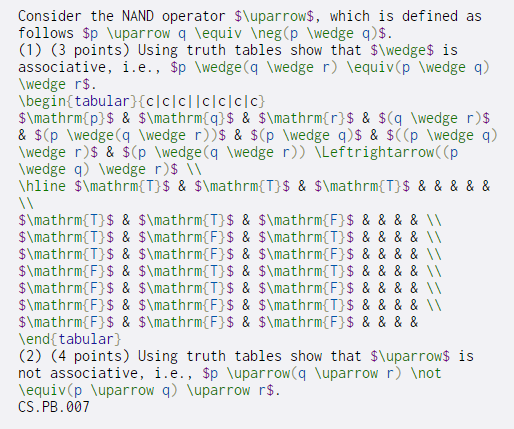
Consider the NAND operator $\uparrows, which is defined as follows $p \uparrow q \equiv eg (p \wedge q)$. (1) (3 points) Using truth tables show that $\wedge$ is associative, i.e., $p \wedge (9 \wedge r \equiv(p \wedge q) \wedge r$. \begin{tabular}{ccccccc} $\mathrm{p}$ & $\mathrm{q}$ & $\mathrm{r}$ & $(9 \wedge r) $ & $(p \wedge (q \wedge r) $ & $(p \wedge q)$ & $(p \wedge q) \wedge r$ & $(p \wedge (q\wedge r)) \leftrightarrow((p \wedge q \wedge r$ \hline $\mathrm{T}$ & $\mathrm{T}$ & $\mathrm{T}$ & & & & & $\mathrm{T}$ & $\mathrm{T}$ & $\mathrm{F} $ & & & & $\mathrm{T}$ & $\mathrm{F}$ & $\mathrm{T}$ & & & & \ $\mathrm{T}$ & $\mathrm{F}$ & $\mathrm{F}$ & & & & W $\mathrm{F}$ & $\mathrm{T}$ & $\mathrm{T}$ & & & & $\mathrm{F}$ & $\mathrm{T}$ & $\mathrm{F}$ & & & & $\mathrm{F}$ & $\mathrm{F}$ & $\mathrm{T}$ & & & & $\mathrm{F}$ & $\mathrm{F}$ & $\mathrm{F}$ & & & & \end{tabular) (2) (4 points) Using truth tables show that $\uparrow$ is not associative, i.e., $p \uparrow \uparrow r ot \equiv(p \uparrow q) \uparrow r$. CS.PB.007
Step by Step Solution
There are 3 Steps involved in it

Get step-by-step solutions from verified subject matter experts