



Question: Consider the Neoclassical Growth Model with exogenous labor: 1. Consider the Neoclassical Growth Model with exogenous labor: The representative household chooses a path of real
Consider the Neoclassical Growth Model with exogenous labor:
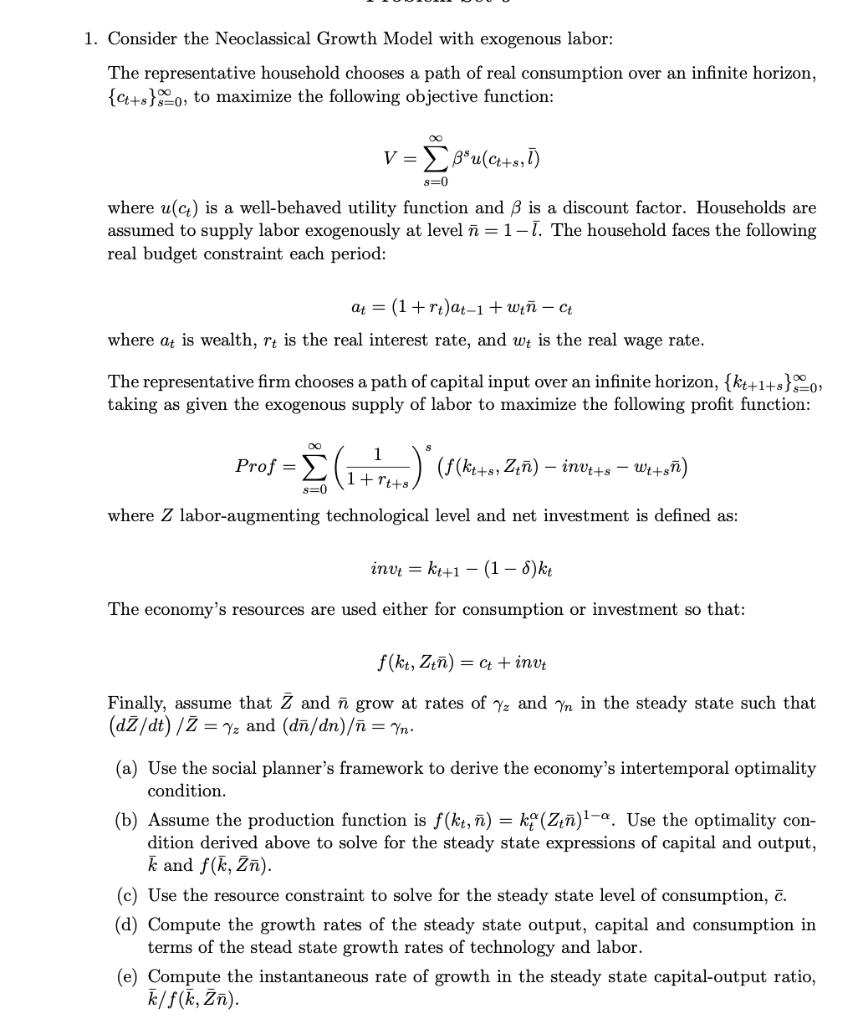
1. Consider the Neoclassical Growth Model with exogenous labor: The representative household chooses a path of real consumption over an infinite horizon, {a+s} , to maximize the following objective function: V= Bu(c+s, ) s=0 where u(q) is a well-behaved utility function and B is a discount factor. Households are assumed to supply labor exogenously at level =1-1. The household faces the following real budget constraint each period: at = (1+rt)at-1 + wi - Ct where at is wealth, rt is the real interest rate, and wt is the real wage rate. The representative firm chooses a path of capital input over an infinite horizon, {kt+1+s} taking as given the exogenous supply of labor to maximize the following profit function: 1 Prof = (Itera)" (skets, Zi) inveto Weton) 1+ s=0 where Z labor-augmenting technological level and net investment is defined as: inut = kt+1 - (1 - 8)kt The economy's resources are used either for consumption or investment so that: f(kt, Zin) = C++ inut Finally, assume that and grow at rates of Yz and Yn in the steady state such that (d/dt) / Z = Y; and (d/dn) = Yn. (a) Use the social planner's framework to derive the economy's intertemporal optimality condition. (b) Assume the production function is f(kt, ) = km (24l-a. Use the optimality con- dition derived above to solve for the steady state expressions of capital and output, k and f(k, Zn). (c) Use the resource constraint to solve for the steady state level of consumption, c. (d) Compute the growth rates of the steady state output, capital and consumption in terms of the stead state growth rates of technology and labor. (e) Compute the instantaneous rate of growth in the steady state capital-output ratio, k/f(k, Zn). 1. Consider the Neoclassical Growth Model with exogenous labor: The representative household chooses a path of real consumption over an infinite horizon, {a+s} , to maximize the following objective function: V= Bu(c+s, ) s=0 where u(q) is a well-behaved utility function and B is a discount factor. Households are assumed to supply labor exogenously at level =1-1. The household faces the following real budget constraint each period: at = (1+rt)at-1 + wi - Ct where at is wealth, rt is the real interest rate, and wt is the real wage rate. The representative firm chooses a path of capital input over an infinite horizon, {kt+1+s} taking as given the exogenous supply of labor to maximize the following profit function: 1 Prof = (Itera)" (skets, Zi) inveto Weton) 1+ s=0 where Z labor-augmenting technological level and net investment is defined as: inut = kt+1 - (1 - 8)kt The economy's resources are used either for consumption or investment so that: f(kt, Zin) = C++ inut Finally, assume that and grow at rates of Yz and Yn in the steady state such that (d/dt) / Z = Y; and (d/dn) = Yn. (a) Use the social planner's framework to derive the economy's intertemporal optimality condition. (b) Assume the production function is f(kt, ) = km (24l-a. Use the optimality con- dition derived above to solve for the steady state expressions of capital and output, k and f(k, Zn). (c) Use the resource constraint to solve for the steady state level of consumption, c. (d) Compute the growth rates of the steady state output, capital and consumption in terms of the stead state growth rates of technology and labor. (e) Compute the instantaneous rate of growth in the steady state capital-output ratio, k/f(k, Zn)
Step by Step Solution
There are 3 Steps involved in it

Get step-by-step solutions from verified subject matter experts