Question: Consider the nonlinear optimization model stated below.Min 2X2 ? 18X + 2XY + Y2 ? 14Y + 51s.t. X + 4Y ? 6(a)Find the minimum

Consider the nonlinear optimization model stated below.Min 2X2 ? 18X + 2XY + Y2 ? 14Y + 51s.t. X + 4Y ? 6(a)Find the minimum solution to this problem.32 Changed: Your submitted answer was incorrect. Your current answer has not been submitted. at (X, Y) = Incorrect: Your answer is incorrect. (b)If the right-hand side of the constraint is increased from 6 to 7, how much do you expect the objective function to change?Based on the dual value on the constraint X + 4Y ? 6, we expect the optimal objective function value to decrease by -8 Changed: Your submitted answer was incorrect. Your current answer has not been submitted. .(c)Resolve the problem with a new right-hand side of the constraint of 7. How does the actual change compare with your estimate?If we resolve the problem with a new right-hand-side of 7 the new optimal objective function value is 40 Incorrect: Your answer is incorrect. , so the actual change is a decrease of 3 Changed: Your submitted answer was incorrect. Your current answer has not been submitted. rather than what we expected in part (b).Consider the nonlinear optimization model statedConsider the nonlinear optimization model stated

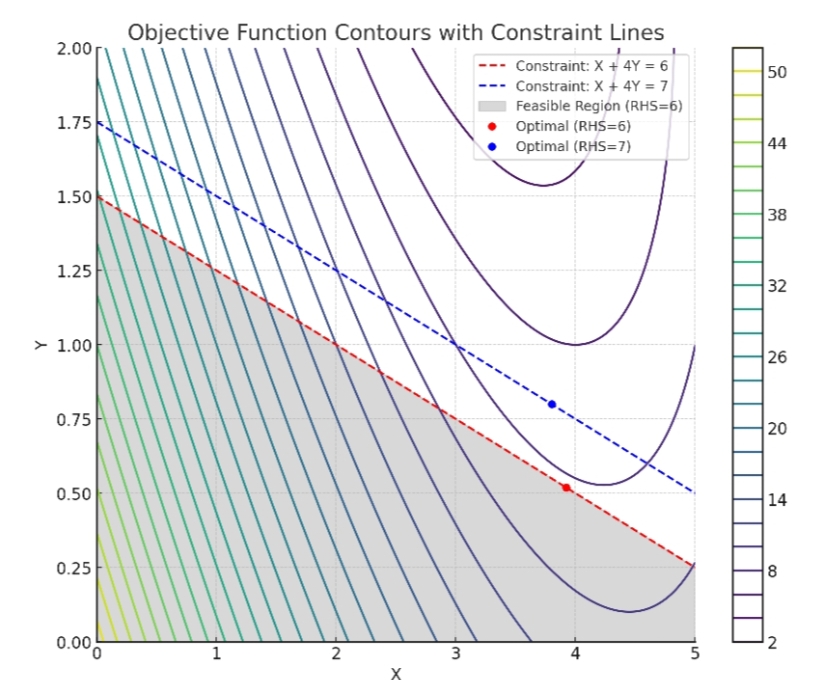
to this problem We solve this using the Karush-Kuhn-Tucke (KKT) conditions, a standard method for nonlinear optimization with inequality constraints. Step 1: Set up the Lagrangian [[X.Y.X)- 2X4 - 18X +2XY +93 -14 +51 4 XX + 4 -6) Here, A 2 0 is the Lagrange multiplier for the nequality constraint Step 2: Compute partial derivatives Set gradients to zero for stationarity: LaTex Copy cod \\frac(\\partial \\mathcal(L}}{\\partial Y) = 2x + 2Y - 14 + 4\\lambda = 0 \\tag(2} ] LaTex copy code (Constraint: ) x + 47 \\leq 6 \\text{Complementary Slackness: } \\lambda (X + 4Y - 6) = 0 \\tag(4) ] since the Cons constraint is active at the minimum (as we will confirm), we set: LaTex copy code X + 4Y - 6 \\Rightarrow X - 6 - 4Y Step 3: Solve the system Substitute Eq (5) into Eq (1) and (2) From (1) LaTex copy code \\Rightarrow 24 - isY - 18 + 24 4 \\lambd . \\Rightarrow \\lambda - -6 . 14 \\tag(6) From (2 LaTex Copy code \\Rightarrow - 2 - 6Y + 4\\lanbe \\fractay . 1)(2) \\tazt7) Step 4: Equate (6) and (7) LaTex Copy code 6 + 149 - Mrac(3Y + 1)12) Rightarrow 257 - 13 \\Rightarrow Y " \\frac(13}(25) \\tag(8) From Eq (5) O Copy code \\frac(52)(25) - \\frac(98)(25) \\caz(9} Step 5: Compute the objective function f(X, Y) - 2X2 - 18X +2XY + Y? - 14Y + 51 Plug in X = , Y = 1 Break into parts: . X = 12 = 2X? = 105 . -18X = -18 . = =1394 . 2XY = 2 . * - 1 = 3545 . -14Y = -14 . # =32 Now sum: f = (10206 +218+160) - (17618182) +51 = \\frac(21925)(625) - \\frac(1946)(25) + 51 = 35.08 - 77.84 + 51 = \\boxed(8.24) ] Final Answer for (a): (x, Y) = 25' 25 ) = 8.24 V (b) Estimate change in HS changes from 6 to 7 Use the Lagrange multiplier > as the shadow price (dual value). From equation (6): A - -6+148 - -6+14-1 --6+ 49 - 18-[2.25] So, increasing RHS by 1 unit is estimated to decrease the objective by: 1.28 V (c) Resolve with new RHS = 7 and compare Now solve the problem again with: LaTex Copy cod * + 4Y - 7 \\Rightarrow x - 7 - 4Y Repeat substitution into the Lagrangian system as in part (a). From stationarity (same steps as above), we get: . Y= =0.8 . X = 7 - 4 .0.8 =7-3.2- 1 - 3.8 Compute new objective: X = 3.8. Y = 0.8 . -18X = -68.4 . 2XY = 6.08 . Yz = 0.64 . -14Y = -11.2 Now: f = 28.88 - 68.4 + 6.08 + 0.64 - 11.2 + 51 = [7.0 Compare: . Previous value: 8.24 New value: 7.0 * Actual change: 8.24 - 7.0 = -1.24 Estimated change from part (b): -1.28 Conclusion: The estimate was very close to the actual value. V Final Answers Summary Part Answer (a) Minimum at /98 13 \\ bbjective value 854 (b) Estimated decrease in objective (from A): -1.28 New optimal value: -1.24 . very close to estimateObjective Function Contours with Constraint Lines 2.00 --- Constraint: X + 4Y = 6 50 -= = Constraint: X + 4Y = 7 Feasible Region (RHS=6) 1.75 Optimal (RHS=6) . Optimal (RHS=7) 44 1.50 38 1.25 32 > 1.00 26 0.75 20 0.50 14 0.25 8 0.00 o 1 2 3 4

Step by Step Solution

There are 3 Steps involved in it

1 Expert Approved Answer
Step: 1 Unlock blur-text-image
Question Has Been Solved by an Expert!

Get step-by-step solutions from verified subject matter experts

Step: 2 Unlock
Step: 3 Unlock

Students Have Also Explored These Related Accounting Questions!