







Question: Consider the problem COMPOSITE: given an integer y, does y have any factors other than one and itself? For this exercise, you may assume that
Consider the problem COMPOSITE: given an integer y, does y have any factors other than one and itself? For this exercise, you may assume that COMPOSITE is in NP, and you will be comparing it to the well-known NP-complete problem SUBSET-SUM: given a set S of n integers and an integer target t, is there a subset of S whose sum is exactly t? Clearly explain whether or not each of the following statements follows from that fact that COMPOSITE is in NP and SUBSET-SUM is NP-complete: a. SUBSET-SUM p COMPOSITE. b. If there is an O(n3) algorithm for SUBSET-SUM, then there is a polynomial time algorithm for COMPOSITE. c. If there is a polynomial algorithm for COMPOSITE, then P = NP. d. If P NP, then no problem in NP can be solved in polynomial time.
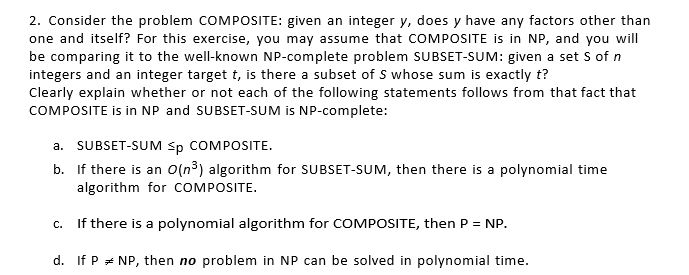
2. Consider the problem COMPOSITE: given an integer y, does y have any factors other than one and itself? For this exercise, you may assume that COMPOSITE is in NP, and you will be comparing it to the well-known NP-complete problem SUBSET-SUM: given a set S of n integers and an integer target t, is there a subset of S whose sum is exactly t? Clearly explain whether or not each of the following statements follows from that fact that COMPOSITE is in NP and SUBSET-SUM is NP-complete: a. SUBSET-SUM Sp COMPOSITE b. If there is an O(n algorithm for SUBSET-SUM, then there is a polyno mial time algorithm for COMPOSITE c. If there is a polynomial algorithm for COMPOSITE, then P NP. d. f P NP, then no problem in NP can be solved in polynomial time 2. Consider the problem COMPOSITE: given an integer y, does y have any factors other than one and itself? For this exercise, you may assume that COMPOSITE is in NP, and you will be comparing it to the well-known NP-complete problem SUBSET-SUM: given a set S of n integers and an integer target t, is there a subset of S whose sum is exactly t? Clearly explain whether or not each of the following statements follows from that fact that COMPOSITE is in NP and SUBSET-SUM is NP-complete: a. SUBSET-SUM Sp COMPOSITE b. If there is an O(n algorithm for SUBSET-SUM, then there is a polyno mial time algorithm for COMPOSITE c. If there is a polynomial algorithm for COMPOSITE, then P NP. d. f P NP, then no problem in NP can be solved in polynomial time
Step by Step Solution
There are 3 Steps involved in it

Get step-by-step solutions from verified subject matter experts
 Study Help