







Question: Consider the protocol architecture shown in Fig. 1 which exists at two nodes A and B. Node A is sending data to node B. The
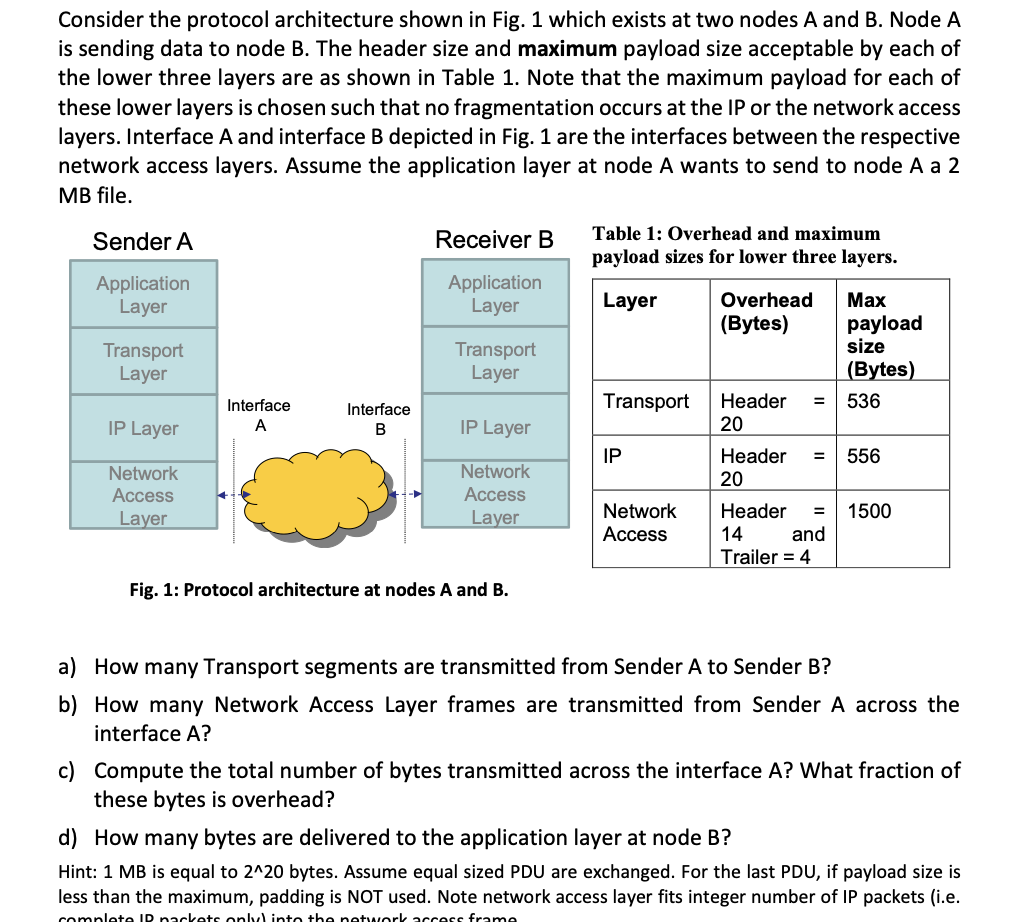
Consider the protocol architecture shown in Fig. 1 which exists at two nodes A and B. Node A is sending data to node B. The header size and maximum payload size acceptable by each of the lower three layers are as shown in Table 1. Note that the maximum payload for each of these lower layers is chosen such that no fragmentation occurs at the IP or the network access layers. Interface A and interface B depicted in Fig. 1 are the interfaces between the respective network access layers. Assume the application layer at node A wants to send to node A a 2 MB file. Sender A Receiver B Table 1: Overhead and maximum payload sizes for lower three layers. Application Layer Application Layer Layer Overhead (Bytes) Transport Layer Transport Layer Max payload size (Bytes) 536 Transport Interface A Interface B Header 20 IP Layer IP Layer IP 556 Network Access Layer Network Access Layer Header = 20 Header 14 and Trailer = 4 = Network Access 1500 Fig. 1: Protocol architecture at nodes A and B. a) How many Transport segments are transmitted from Sender A to Sender B? b) How many Network Access Layer frames are transmitted from Sender A across the interface A? c) Compute the total number of bytes transmitted across the interface A? What fraction of these bytes is overhead? d) How many bytes are delivered to the application layer at node B? Hint: 1 MB is equal to 2120 bytes. Assume equal sized PDU are exchanged. For the last PDU, if payload size is less than the maximum, padding is NOT used. Note network access layer fits integer number of IP packets (i.e. nackets only into the
Step by Step Solution
There are 3 Steps involved in it

Get step-by-step solutions from verified subject matter experts
 Study Help