







Question: Consider the queuing system shown belovw connection Server 1 erver 2 C1 C2 connection2* TDM SM connection3 Server 1 has a capacity of C1-100bits/sec. It
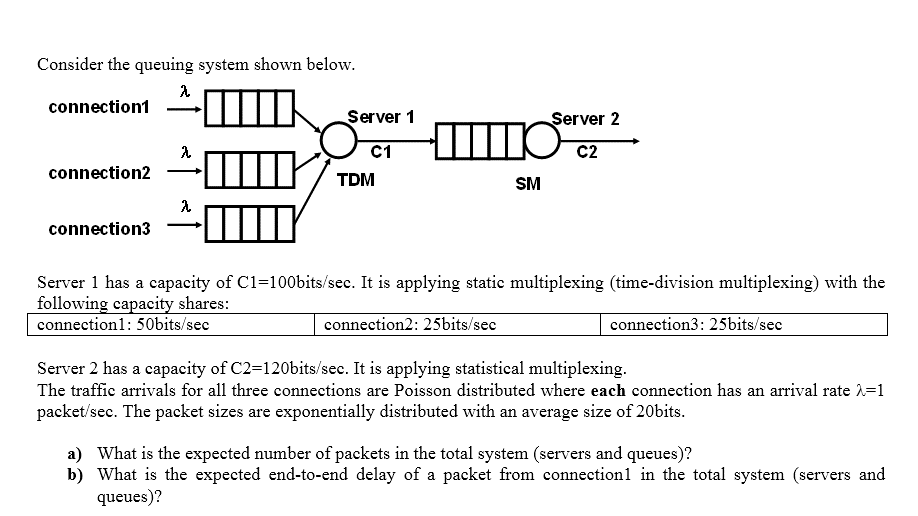
Consider the queuing system shown belovw connection Server 1 erver 2 C1 C2 connection2* TDM SM connection3 Server 1 has a capacity of C1-100bits/sec. It is applying static multiplexing (time-division multiplexing) with the following capacity shares connection1: 50bits/sec connection2: 25bits/sec connection3: 25bits/sec Server 2 has a capacity of C2-120bits/sec. It is applying statistical multiplexing The traffic arrivals for all three connections are Poisson distributed where each connection has an arrival rate X 1 packet/sec. The packet sizes are exponentially distributed with an average size of 20bits a) What is the expected number of packets in the total system (servers and queues)? b) What is the expected end-to-end delay of a packet from connectionl in the total system (servers and queues)? Consider the queuing system shown belovw connection Server 1 erver 2 C1 C2 connection2* TDM SM connection3 Server 1 has a capacity of C1-100bits/sec. It is applying static multiplexing (time-division multiplexing) with the following capacity shares connection1: 50bits/sec connection2: 25bits/sec connection3: 25bits/sec Server 2 has a capacity of C2-120bits/sec. It is applying statistical multiplexing The traffic arrivals for all three connections are Poisson distributed where each connection has an arrival rate X 1 packet/sec. The packet sizes are exponentially distributed with an average size of 20bits a) What is the expected number of packets in the total system (servers and queues)? b) What is the expected end-to-end delay of a packet from connectionl in the total system (servers and queues)
Step by Step Solution
There are 3 Steps involved in it

Get step-by-step solutions from verified subject matter experts
 Study Help