





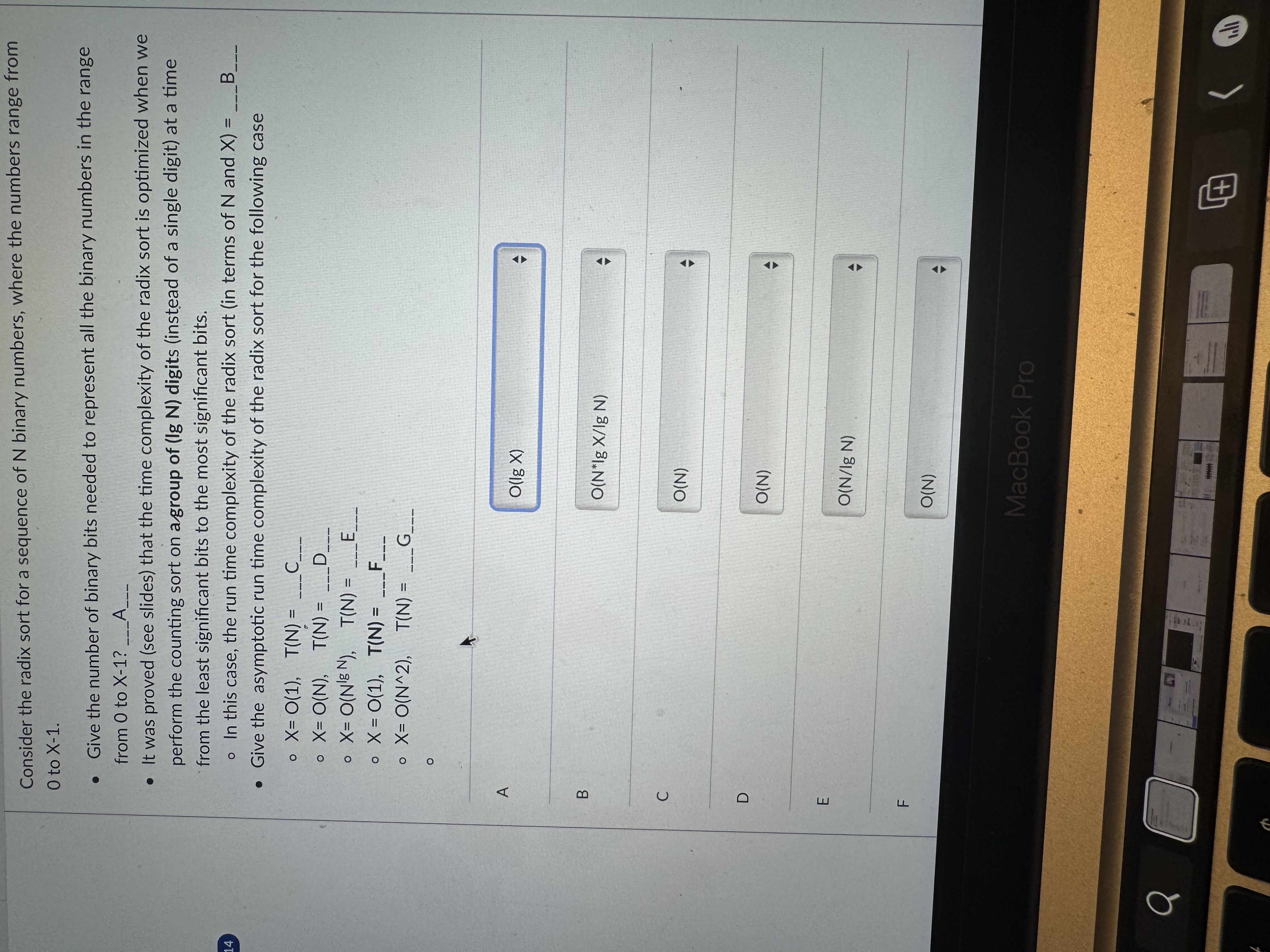
Question: Consider the radix sort for a sequence of N binary numbers, where the numbers range from 0 to X-1. . Give the number of binary
Consider the radix sort for a sequence of NConsider the radix sort for a sequence of N
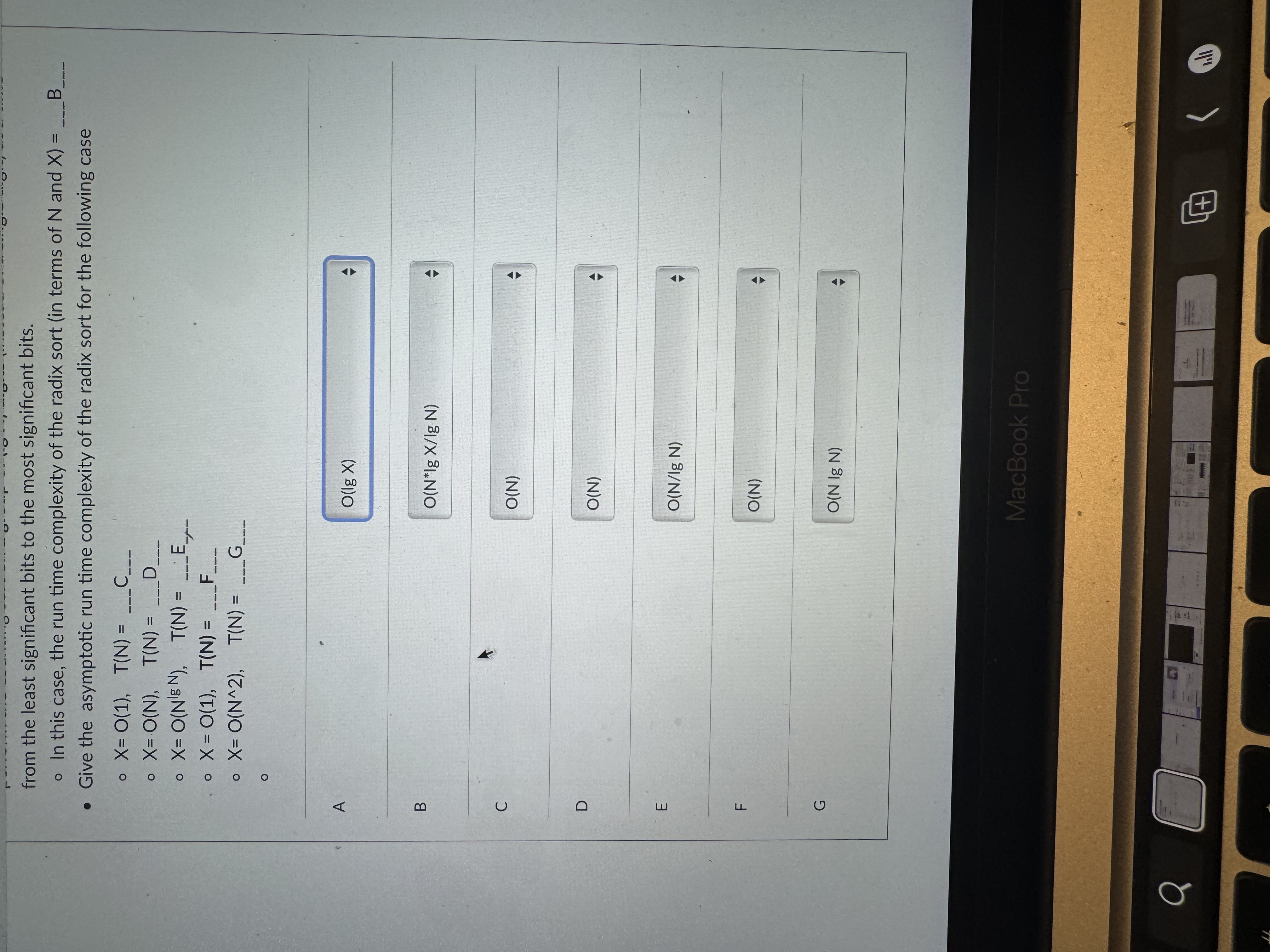
Consider the radix sort for a sequence of N binary numbers, where the numbers range from 0 to X-1. . Give the number of binary bits needed to represent all the binary numbers in the range from 0 to X-1? _ A_ . It was proved (see slides) that the time complexity of the radix sort is optimized when we perform the counting sort on a group of (Ig N) digits (instead of a single digit) at a time from the least significant bits to the most significant bits. o In this case, the run time complexity of the radix sort (in terms of N and X) = __B_ . Give the asymptotic run time complexity of the radix sort for the following case o X= 0(1), T(N ) = ___ C_ __ O X= O(N), T(N) = __D. O X= O(N'8 N), T(N) = _ _E_ o X = 0(1), T(N) = _F_ _ O X= O(N^ 2), T(N ) = _G_ A O(lg X) B O(N*1g X/Ig N) C O(N) D O(N) E O(N/Ig N) F O(N) MacBook Pro Qfrom the least significant bits to the most significant bits. o In this case, the run time complexity of the radix sort (in terms of N and X) = _B_ . Give the asymptotic run time complexity of the radix sort for the following case o X= 0(1), T(N ) = _ __ C___ O X= O(N), T(N) = _ _ _D_ O X= O(N'S N), T(N ) = _ _E_ o X = 0(1), T(N ) = _ _ _F___ O X= O(N^2), T(N ) = ___G_ A O(lg X) B O(N*1g X/Ig N) C O(N) D O(N) m O(N/Ig N) D(N) G O(N Ig N) MacBook Pro

Step by Step Solution

There are 3 Steps involved in it

1 Expert Approved Answer
Step: 1 Unlock blur-text-image

Question Has Been Solved by an Expert!

Get step-by-step solutions from verified subject matter experts

Step: 2 Unlock
Step: 3 Unlock

Students Have Also Explored These Related Accounting Questions!