







Question: Consider the random variable T defined in the previous problem (i.e., the first arrival). Suppose that, as you're looking at your watch, you note that
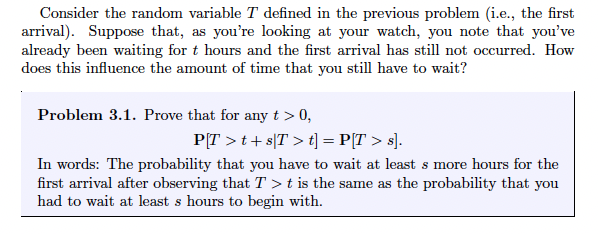
Consider the random variable T defined in the previous problem (i.e., the first arrival). Suppose that, as you're looking at your watch, you note that you've already been waiting for t hours and the first arrival has still not occurred. How does this influence the amount of time that you still have to wait? Problem 3.1. Prove that for any t > 0, PT > t+ sT > t] = P[T > s]. In words: The probability that you have to wait at least s more hours for the first arrival after observing that T' > t is the same as the probability that you had to wait at least s hours to begin with
Step by Step Solution
There are 3 Steps involved in it
1 Expert Approved Answer
Step: 1 Unlock

Question Has Been Solved by an Expert!
Get step-by-step solutions from verified subject matter experts
Step: 2 Unlock
Step: 3 Unlock
 Study Help