







Question: Consider the recursive relation x_(t+1)=c(4x_(t))/(1+x_(t)) where c>0 is an unknown constant. (a) Find all equilibrium points. Answer: x= and x= (b) For
Consider the recursive relation\
x_(t+1)=c(4x_(t))/(1+x_(t))\ where
c>0is an unknown constant.\ (a) Find all equilibrium points.\ Answer:
x=\ and
x=\ (b) For which values of
cis the zero equilibrium stable and the other one unstable?\ Answer:
c\ (c) For which values of
cis the zero equilibrium unstable and the other one stable?\ Answer:
c\ (d) Let us call
c^(**)the critical value that distinguishes the two cases above. What is the\ value of
c^(**)?\ Answer:
c^(**)=\ (e) In the case of
c=c^(**), we cannot say anything about the stability since
|f^(')((\\\\bar{x} ))|= 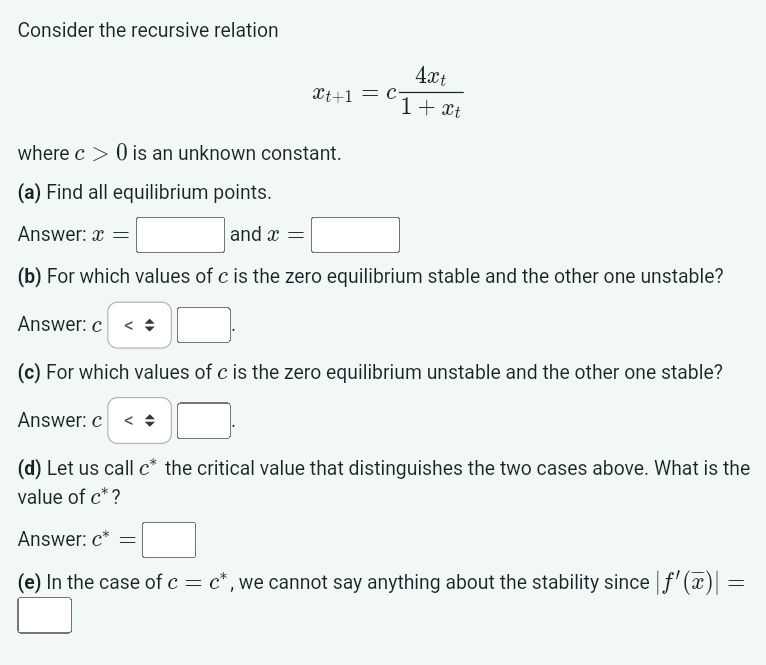
Consider the recursive relation xt+1=c1+xt4xt where c>0 is an unknown constant. (a) Find all equilibrium points. Answer: x= and x= (b) For which values of c is the zero equilibrium stable and the other one unstable? Answer: c (c) For which values of c is the zero equilibrium unstable and the other one stable? Answer: c (d) Let us call c the critical value that distinguishes the two cases above. What is the value of c ? Answer: c= (e) In the case of c=c, we cannot say anything about the stability since f(x)=
Step by Step Solution
There are 3 Steps involved in it

Get step-by-step solutions from verified subject matter experts
 Study Help