







Question: Consider the relational schema R(A, B, C, D), and the dependencies AB C, BD, C A, and D A. (a) (3p.) Is the relation
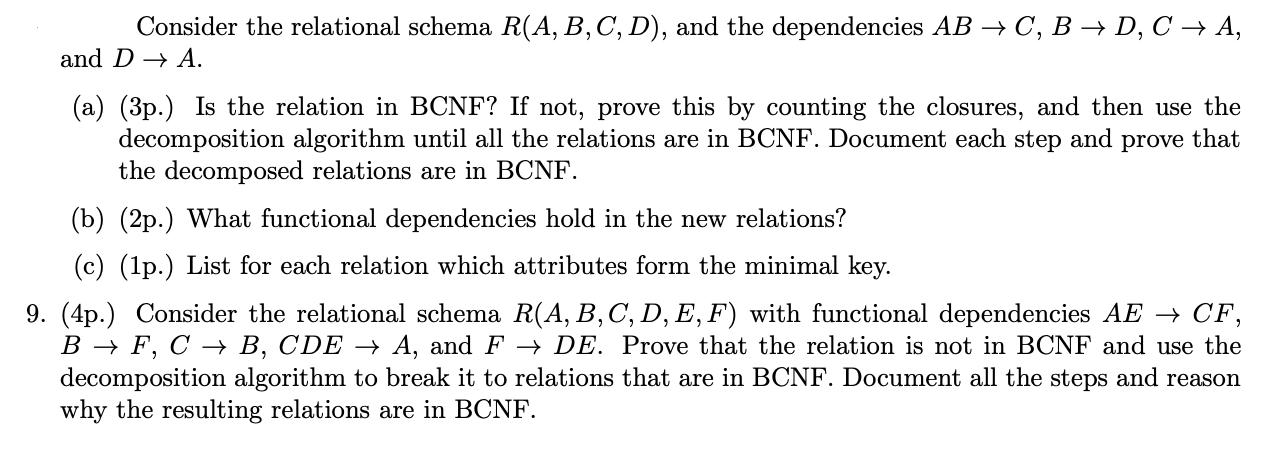
Consider the relational schema R(A, B, C, D), and the dependencies AB C, BD, C A, and D A. (a) (3p.) Is the relation in BCNF? If not, prove this by counting the closures, and then use the decomposition algorithm until all the relations are in BCNF. Document each step and prove that the decomposed relations are in BCNF. (b) (2p.) What functional dependencies hold in the new relations? (c) (1p.) List for each relation which attributes form the minimal key. 9. (4p.) Consider the relational schema R(A, B, C, D, E, F) with functional dependencies AE CF, B F, C B, CDE A, and F DE. Prove that the relation is not in BCNF and use the decomposition algorithm to break it to relations that are in BCNF. Document all the steps and reason why the resulting relations are in BCNF.
Step by Step Solution
3.43 Rating (156 Votes )
There are 3 Steps involved in it
Solution Given Schema RABCDEF Set of functional dependencies B D AB C AB E AB F AC F ACE D AEF B AEF ... View full answer

Get step-by-step solutions from verified subject matter experts
 Study Help