



Question: Consider the scenario shown in the Figure below in which a server is connected to a router by an 80Mbps link with a 50ms
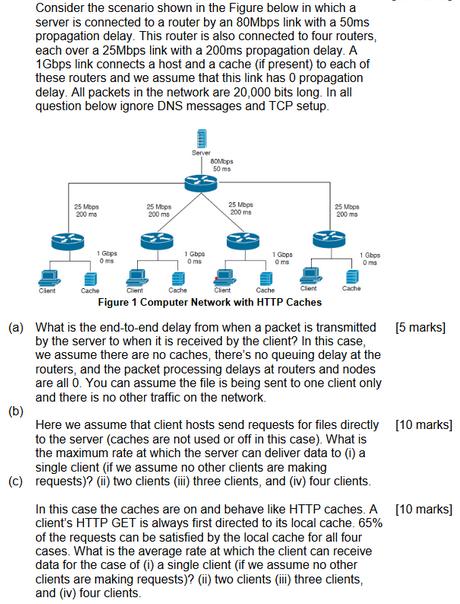
Consider the scenario shown in the Figure below in which a server is connected to a router by an 80Mbps link with a 50ms propagation delay. This router is also connected to four routers, each over a 25Mbps link with a 200ms propagation delay. A 1Gbps link connects a host and a cache (if present) to each of these routers and we assume that this link has 0 propagation delay. All packets in the network are 20,000 bits long. In all question below ignore DNS messages and TCP setup. Cient 25 M 200 m 1 Geps 25 M Cache 200 m Server 1 Gbps Oms 80Mbps 50 m 25 Mbps 200 m 1 Gops Oms Cache Cache Client Figure 1 Computer Network with HTTP Caches 25 Mbps 200 m 1 Gbps Cache (a) What is the end-to-end delay from when a packet is transmitted [5 marks] by the server to when it is received by the client? In this case, we assume there are no caches, there's no queuing delay at the routers, and the packet processing delays at routers and nodes are all 0. You can assume the file is being sent to one client only and there is no other traffic on the network. (b) Here we assume that client hosts send requests for files directly [10 marks] to the server (caches are not used or off in this case). What is the maximum rate at which the server can deliver data to (i) a single client (if we assume no other clients are making (c) requests)? (ii) two clients (iii) three clients, and (iv) four clients. In this case the caches are on and behave like HTTP caches. A [10 marks] client's HTTP GET is always first directed to its local cache. 65% of the requests can be satisfied by the local cache for all four cases. What is the average rate at which the client can receive data for the case of (i) a single client (if we assume no other clients are making requests)? (ii) two clients (iii) three clients, and (iv) four clients.
Step by Step Solution
3.42 Rating (142 Votes )
There are 3 Steps involved in it
a The endtoend delay from when a packet is transmitted by the server to when it is received by the c... View full answer

Get step-by-step solutions from verified subject matter experts