







Question: Consider the sets, X = {1, 2, 3, 4, 5} Y = {a, b, c, d, e} R = { (1,1), (1,2), (2,2), (2,1), (2,3),
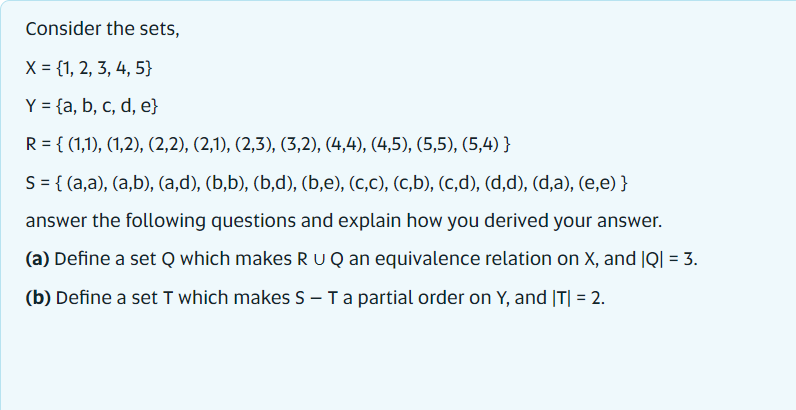
Consider the sets, X = {1, 2, 3, 4, 5} Y = {a, b, c, d, e} R = { (1,1), (1,2), (2,2), (2,1), (2,3), (3,2), (4,4), (4,5), (5,5), (5,4) } S = { (a,a), (a,b), (a,d), (b,b), (b,d), (b,e), (c,c), (c,b), (c,d), (d,d), (d,a), (e,e) } answer the following questions and explain how you derived your answer. (a) Define a set Q which makes R U Q an equivalence relation on X, and |Q| = 3. (b) Define a set T which makes S - T a partial order on Y, and IT| = 2
Step by Step Solution
There are 3 Steps involved in it
1 Expert Approved Answer
Step: 1 Unlock

Question Has Been Solved by an Expert!
Get step-by-step solutions from verified subject matter experts
Step: 2 Unlock
Step: 3 Unlock
 Study Help