







Question: Consider the shape a Liquid drop assumes when placed on a smooth horizontal surface, as depicted in Fig. 3 . The liquid drop's shape will
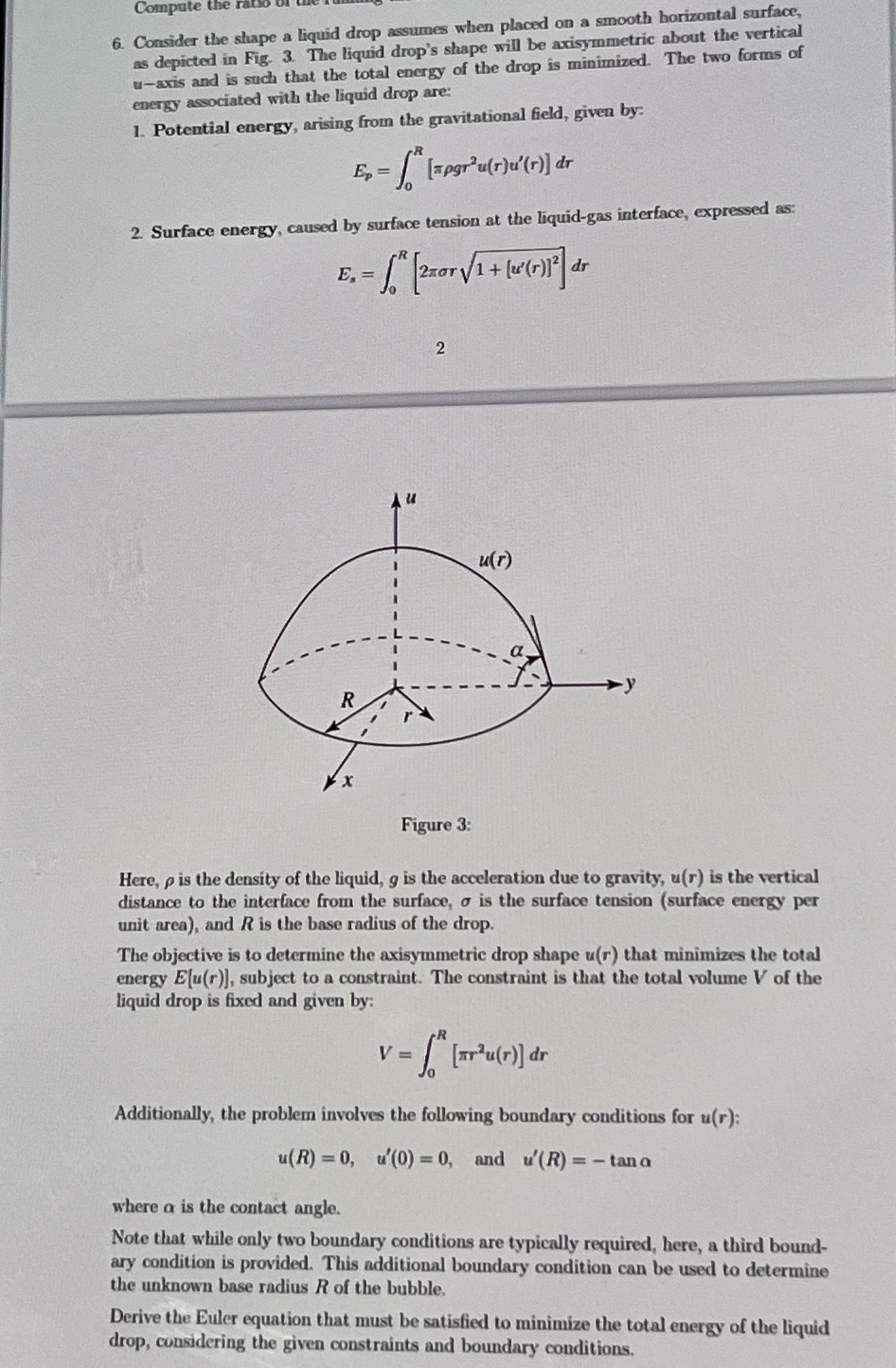
Consider the shape a Liquid drop assumes when placed on a smooth horizontal surface, as depicted in Fig. The liquid drop's shape will be axisymmetric about the vertical axis and is such that the total energy of the drop is minimized. The two forms of energy associated with the liquid drop are:
Potential energy, arising from the gravitational field, given by:
Surface energy, caused by surface tension at the liquidgas interface, expressed as:
Here, is the density of the liquid, is the acceleration due to gravity; is the vertical distance to the interface from the surface, is the surface tension surface energy per unit area and is the base radius of the drop.
The objective is to determine the axisymmetric drop shape that minimizes the total energy subject to a constraint. The constraint is that the total volume of the liquid drop is fixed and given by:
Additionally, the problem involves the following boundary conditions for ;
and
where is the contact angle.
Note that while only two boundary conditions are typically required, here, a third boundary condition is provided. This additional boundary condition can be used to determine the unknown base radius of the bubble.
Derive the Euler equation that must be satisfied to minimize the total energy of the liquid drop, considering the given constraints and boundary conditions.
Step by Step Solution
There are 3 Steps involved in it
1 Expert Approved Answer
Step: 1 Unlock

Question Has Been Solved by an Expert!
Get step-by-step solutions from verified subject matter experts
Step: 2 Unlock
Step: 3 Unlock
 Study Help