







Question: Consider the simply typed -calculus and its typing rules defined in Note 3. Suppose we want to add a new operation which performs the xor
Consider the simply typed -calculus and its typing rules defined in Note 3. Suppose we want to add a new operation which performs the xor operation on two booleans. We can define the syntax of this new language as follows:
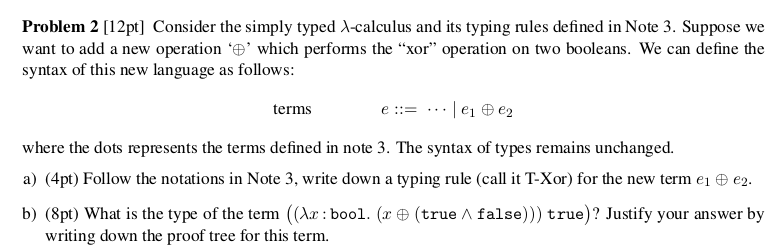
Problem 2 [12pt] Consider the simply typed -calculus and its typing rules defined in Note 3. Suppose we want to add a new operation , which performs the "Xor" operation on two booleans. We can define the syntax of this new language as follows: terms |el e2 e:= where the dots represents the terms defined in note 3. The syntax of types remains unchanged. ) (4pt) Follow the notations in Note 3, write down a typing rule (call t T-Xor) for the new terme e2. b) (8pt) what is the type of the tem (Az: bool. (x (true false)) true)? Justify your answer by writing down the proof tree for this term. Problem 2 [12pt] Consider the simply typed -calculus and its typing rules defined in Note 3. Suppose we want to add a new operation , which performs the "Xor" operation on two booleans. We can define the syntax of this new language as follows: terms |el e2 e:= where the dots represents the terms defined in note 3. The syntax of types remains unchanged. ) (4pt) Follow the notations in Note 3, write down a typing rule (call t T-Xor) for the new terme e2. b) (8pt) what is the type of the tem (Az: bool. (x (true false)) true)? Justify your answer by writing down the proof tree for this term
Step by Step Solution
There are 3 Steps involved in it

Get step-by-step solutions from verified subject matter experts
 Study Help