



Question: Consider the skulls data in HSAUR3 package in R, we observe data from multiple independent populations. The dataset contains observation on 4 variables for 150
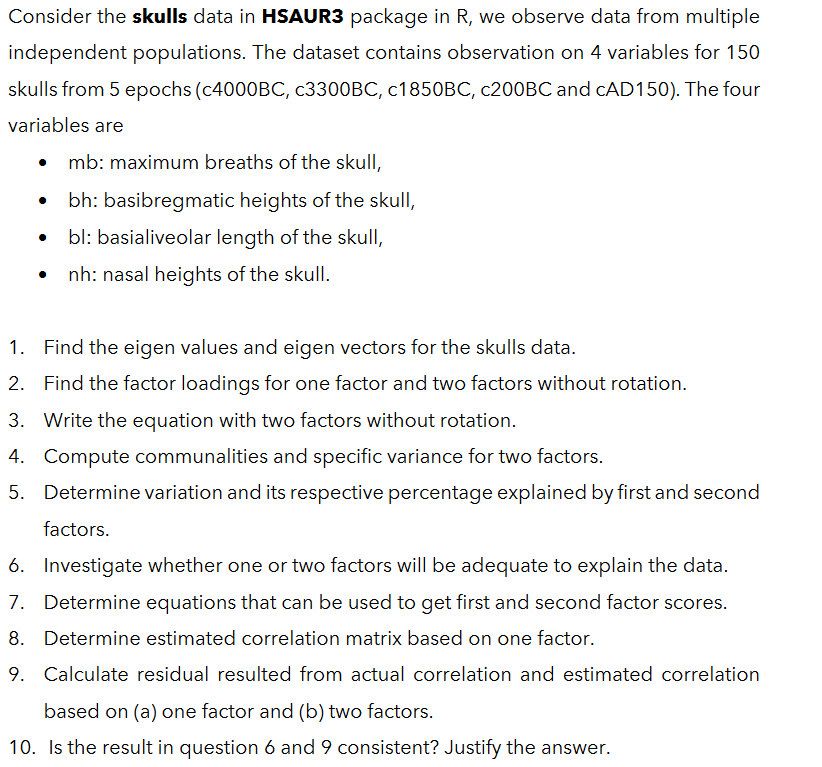
Consider the skulls data in HSAUR3 package in R, we observe data from multiple independent populations. The dataset contains observation on 4 variables for 150 skulls from 5 epochs (C4000BC, c3300BC, c1850BC, c200BC and CAD150). The four variables are mb: maximum breaths of the skull, bh: basibregmatic heights of the skull, bl: basialiveolar length of the skull, nh: nasal heights of the skull. . . 1. Find the eigen values and eigen vectors for the skulls data. 2. Find the factor loadings for one factor and two factors without rotation. 3. Write the equation with two factors without rotation. 4. Compute communalities and specific variance for two factors. 5. Determine variation and its respective percentage explained by first and second factors. 6. Investigate whether one or two factors will be adequate to explain the data. 7. Determine equations that can be used to get first and second factor scores. 8. Determine estimated correlation matrix based on one factor. 9. Calculate residual resulted from actual correlation and estimated correlation based on (a) one factor and (b) two factors. 10. Is the result in question 6 and 9 consistent? Justify the
Step by Step Solution
There are 3 Steps involved in it

Get step-by-step solutions from verified subject matter experts