







Question: Consider the Solow model with population growth and technological progress. The population grows at rate of and the technology grows at rate of . The
Consider the Solow model with population growth and technological progress. The population grows at rate of and the technology grows at rate of . The depreciation rate of capital is . The Cobb Douglas aggregate production function is given as Y=25 ! " where Y, K, L, and refers to aggregate output, aggregate capital stock, aggregate labor, output elasticity with respect to capital and output elasticity with respect to labor, respectively. a. Explain what is meant by the golden rule level of capital per worker. b. Derive a condition for when golden rule level of capital per worker is reached and write down the resulting condition explicitly using the related parameters given in the question. c. Illustrate your answer in a diagram and label the axes precisely. d. Policymakers often try to improve long-run living standards with policies aimed at increasing the capital-labor ratio by stimulating saving and investment. However, there are limits to this strategy. Why? Explain in words or use any diagrams. e. What restriction should we put on to avoid from diminishing marginal productivity of physical capital? [2 points] Why does this kind of modification on output elasticity matter for sustainability of long-run economic growth?
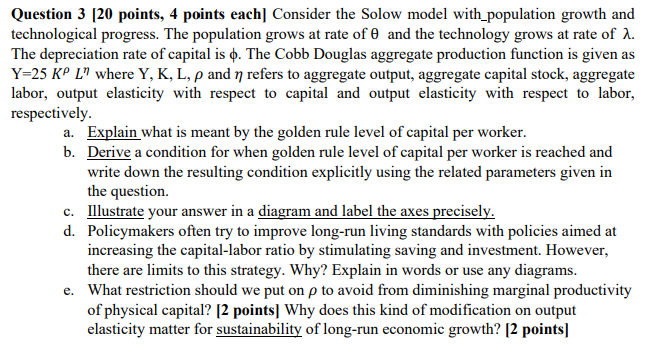
Question 3 (20 points, 4 points each] Consider the Solow model with_population growth and technological progress. The population grows at rate of 8 and the technology grows at rate of 2. The depreciation rate of capital is $. The Cobb Douglas aggregate production function is given as Y=25 K L" where Y, K, L, p and n refers to aggregate output, aggregate capital stock, aggregate labor, output elasticity with respect to capital and output elasticity with respect to labor, respectively. a. Explain what is meant by the golden rule level of capital per worker. b. Derive a condition for when golden rule level of capital per worker is reached and write down the resulting condition explicitly using the related parameters given in the question. c. Illustrate your answer in a diagram and label the axes precisely. d. Policymakers often try to improve long-run living standards with policies aimed at increasing the capital-labor ratio by stimulating saving and investment. However, there are limits to this strategy. Why? Explain in words or use any diagrams. e. What restriction should we put on p to avoid from diminishing marginal productivity of physical capital? [2 points] Why does this kind of modification on output elasticity matter for sustainability of long-run economic growth? [2 points]
Step by Step Solution
There are 3 Steps involved in it

Get step-by-step solutions from verified subject matter experts
 Study Help