







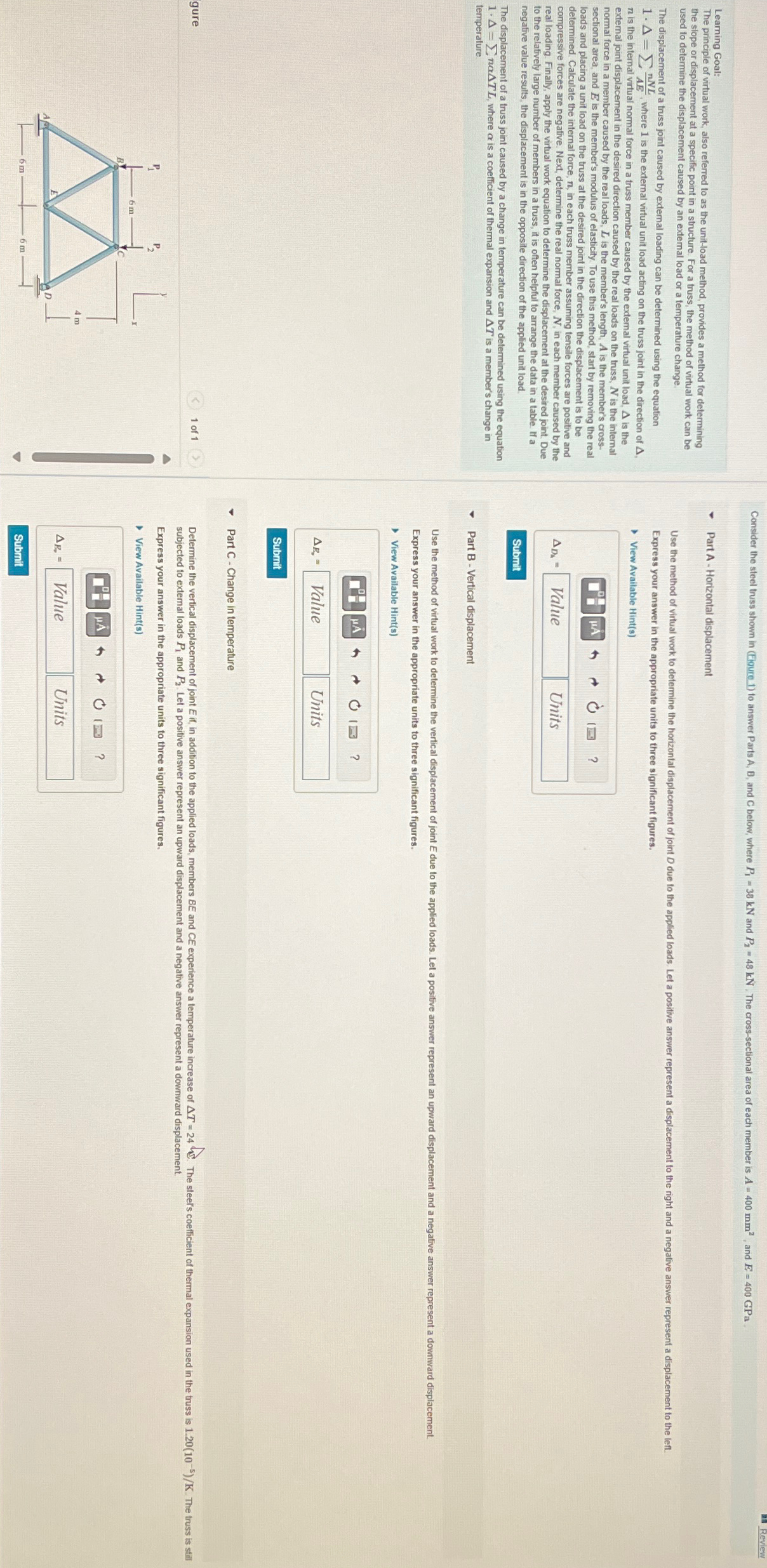
Question: Consider the steel truss shown in ( Eipure 1 ) to answer Parts A , B , and C below, where P 1 = 3
Consider the steel truss shown in Eipure to answer Parts A B and C below, where and The crosssectional area of each member is and GPa.
Learning Goal:
The principle of virtual work, also referred to as the unitload method, provides a method for determining the slope or displacement at a specific point in a structure For a truss, the method of virtual work can be used to determine the displacement caused by an extemal load or a temperature change.
The displacement of a truss joint caused by exdernal loading can be determined using the equation
where is the external virtual unit load acting on the truss joint in the direction of is the internal virtual normal force in a truss member caused by the exdemal virtual unit load, is the external joint displacement in the desired direction caused by the real loads on the truss, is the internal normal force in a member caused by the real loads, is the member's length, is the member's crosssectional area, and is the member's modulus of elasticity. To use this method, start by removing the real loads and placing a unit load on the truss at the desired joint in the direction the displacement is to be determined. Calculate the internal force, in each truss member assuming tensile forces are positive and compressive forces are negative. Next, determine the real normal force, in each member caused by the real loading. Finally, apply the virtual work equation to determine the displacement at the desired joint. Due to the relatively large number of members in a truss, it is often helpful to arrange the data in a table. If a negative value results, the displacement is in the opposite direction of the applied unit load.
The displacement of a truss joint caused by a change in temperature can be determined using the equation where is a coefficient of thermal expansion and is a member's change in temperature
gure
of no
Step by Step Solution
There are 3 Steps involved in it
1 Expert Approved Answer
Step: 1 Unlock

Question Has Been Solved by an Expert!
Get step-by-step solutions from verified subject matter experts
Step: 2 Unlock
Step: 3 Unlock
 Study Help