







Question: Consider the symmetric trapezoidal wing defined by (S = constant = 16 m ^ 2): The profiles are symmetrical and without curvature. 1. Use the
Consider the symmetric trapezoidal wing defined by (S = constant = 16 m ^ 2):
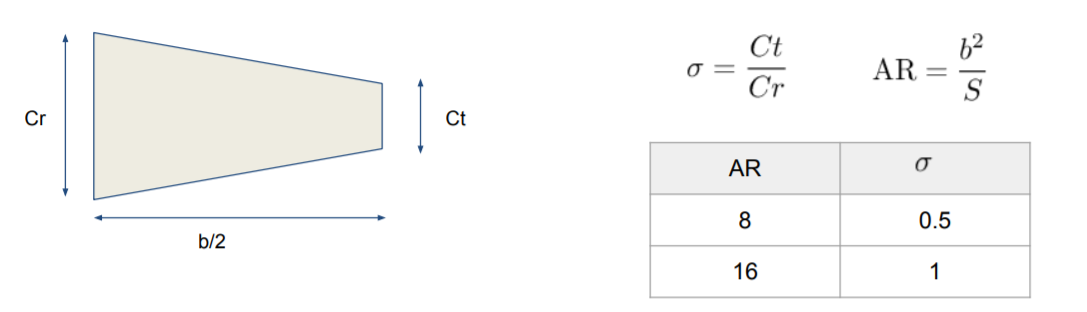 The profiles are symmetrical and without curvature. 1. Use the Lifting line theory to calculate the variations of Cl, e and Cdi for the angles [0.5,5). Consider only terms 1 and 3 at stations = /2, /4

1.1. Determine the 2x2 system of equations that expresses the dependence of the coefficients An with the angle at the stations = /2, /4
1.2. Solve the system for the specified range of angles of attack[0.5,5]
1.3. Represent on the same graph for all wings the variation of
a. e vs. CI
b. Cdi vs. CI
1.4. Comment on the results obtained, focusing on the influence of the parameters AR y on the value of Cdi and e
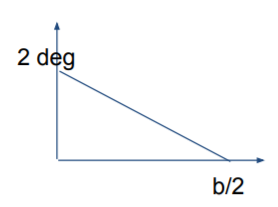
2. Consider a linear distribution of twist angles in the wing. How is the 2x2 system previously calculated modified?
2.1. Calculate the values of the An for the wing AR = 16, = 0.5
2.2. Discuss the changes in the variations of e and Cdi vs. Cl introduced by twist compared to the same wing without twist.
Ct o = AR = Cr Ct AR 8 0.5 b/2 16 1 N N 2b sin . () = , sin, + (+, sin Oo 2 deg b/2 Ct o = AR = Cr Ct AR 8 0.5 b/2 16 1 N N 2b sin . () = , sin, + (+, sin Oo 2 deg b/2
Step by Step Solution
There are 3 Steps involved in it

Get step-by-step solutions from verified subject matter experts
 Study Help