







Question: Consider the system 1. Use any direct method (i.e., analytic method) you know to solve for x,y and z. 2. For the Iterative methods,
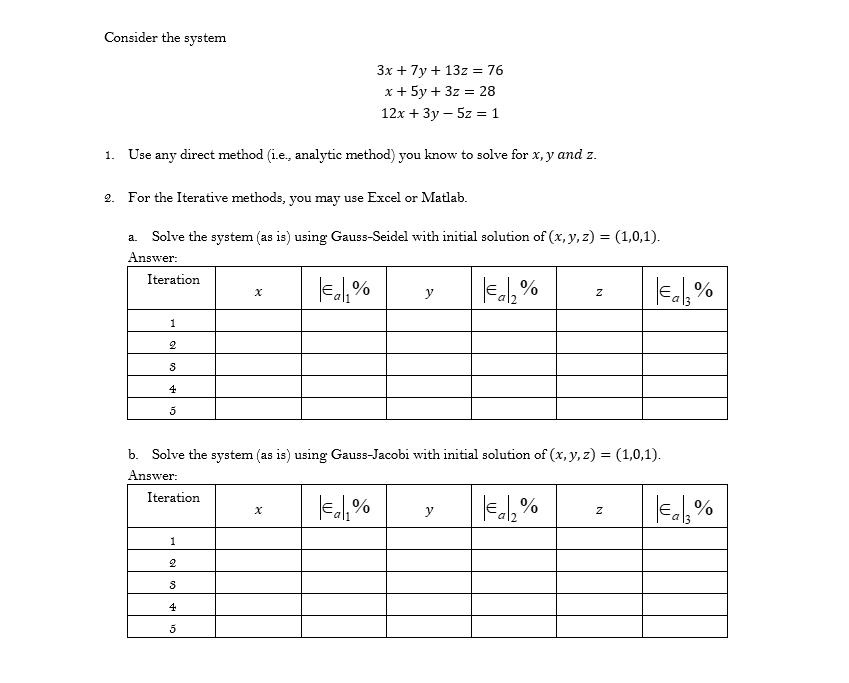
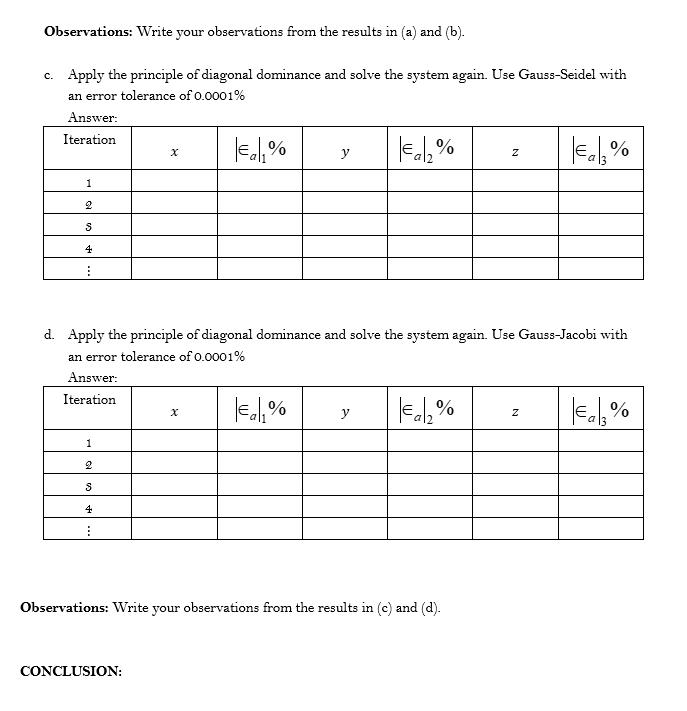
Consider the system 1. Use any direct method (i.e., analytic method) you know to solve for x,y and z. 2. For the Iterative methods, you may use Excel or Matlab. Solve the system (as is) using Gauss-Seidel with initial solution of (x, y, z) = (1,0,1). Answer: Iteration 1,% a% a. 1 2 S 4 5 Iteration 3x + 7y + 13z = 76 x + 5y + 3z = 28 12x + 3y - 5z = 1 1 2 S 4 5 b. Solve the system (as is) using Gauss-Jacobi with initial solution of (x, y, z) = (1,0,1). Answer: X y al% y Z a% als% Z a% Observations: Write your observations from the results in (a) and (b). c. Apply the principle of diagonal dominance and solve the system again. Use Gauss-Seidel with an error tolerance of 0.0001% Answer: Iteration 1 2 S 4 1 2 S 4 I X al% y CONCLUSION: a2% d. Apply the principle of diagonal dominance and solve the system again. Use Gauss-Jacobi with an error tolerance of 0.0001% Answer: Iteration al% y a% Observations: Write your observations from the results in (c) and (d). Z a% Z als% Consider the system 1. Use any direct method (i.e., analytic method) you know to solve for x,y and z. 2. For the Iterative methods, you may use Excel or Matlab. Solve the system (as is) using Gauss-Seidel with initial solution of (x, y, z) = (1,0,1). Answer: Iteration 1,% a% a. 1 2 S 4 5 Iteration 3x + 7y + 13z = 76 x + 5y + 3z = 28 12x + 3y - 5z = 1 1 2 S 4 5 b. Solve the system (as is) using Gauss-Jacobi with initial solution of (x, y, z) = (1,0,1). Answer: X y al% y Z a% als% Z a% Observations: Write your observations from the results in (a) and (b). c. Apply the principle of diagonal dominance and solve the system again. Use Gauss-Seidel with an error tolerance of 0.0001% Answer: Iteration 1 2 S 4 1 2 S 4 I X al% y CONCLUSION: a2% d. Apply the principle of diagonal dominance and solve the system again. Use Gauss-Jacobi with an error tolerance of 0.0001% Answer: Iteration al% y a% Observations: Write your observations from the results in (c) and (d). Z a% Z als%
Step by Step Solution
3.66 Rating (164 Votes )
There are 3 Steps involved in it

Get step-by-step solutions from verified subject matter experts
 Study Help