



Question: Consider the system shown in the figure. ( Figure 1 ) It consists of a block of mass m attached to a spring of negligible
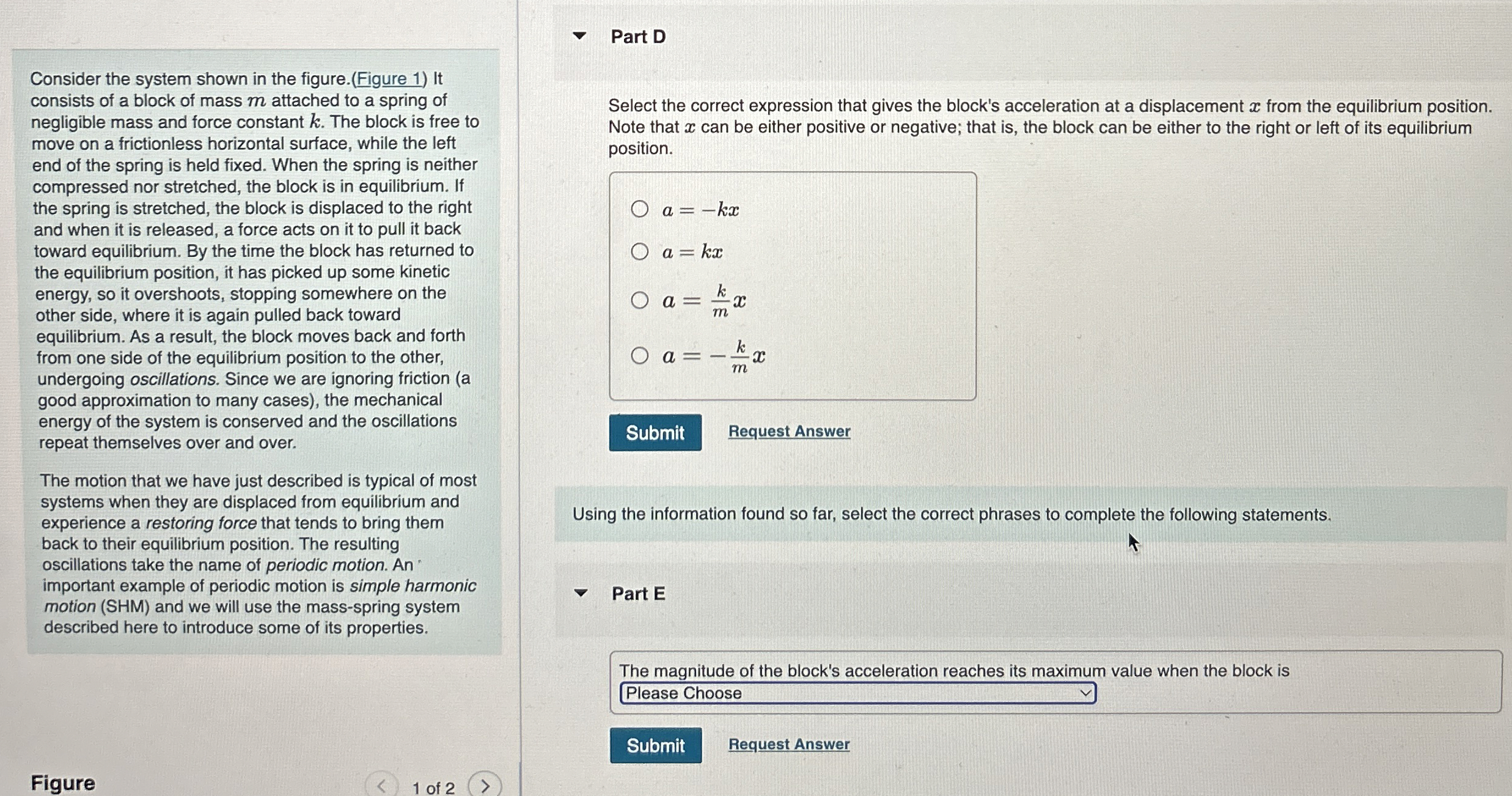
Consider the system shown in the figure. Figure It consists of a block of mass attached to a spring of negligible mass and force constant The block is free to move on a frictionless horizontal surface, while the left end of the spring is held fixed. When the spring is neither compressed nor stretched, the block is in equilibrium. If the spring is stretched, the block is displaced to the right and when it is released, a force acts on it to pull it back toward equilibrium. By the time the block has returned to the equilibrium position, it has picked up some kinetic energy, so it overshoots, stopping somewhere on the other side, where it is again pulled back toward equilibrium. As a result, the block moves back and forth from one side of the equilibrium position to the other, undergoing oscillations. Since we are ignoring friction a good approximation to many cases the mechanical energy of the system is conserved and the oscillations repeat themselves over and over.
The motion that we have just described is typical of most systems when they are displaced from equilibrium and experience a restoring force that tends to bring them back to their equilibrium position. The resulting oscillations take the name of periodic motion. An important example of periodic motion is simple harmonic motion SHM and we will use the massspring system described here to introduce some of its properties.
Part D
Select the correct expression that gives the block's acceleration at a displacement from the equilibrium position. Note that can be either positive or negative; that is the block can be either to the right or left of its equilibrium position.
Request Answer
Using the information found so far, select the correct phrases to complete the following statements.
Part E
Request Answer
Figure
of
Step by Step Solution
There are 3 Steps involved in it
1 Expert Approved Answer
Step: 1 Unlock

Question Has Been Solved by an Expert!
Get step-by-step solutions from verified subject matter experts
Step: 2 Unlock
Step: 3 Unlock