







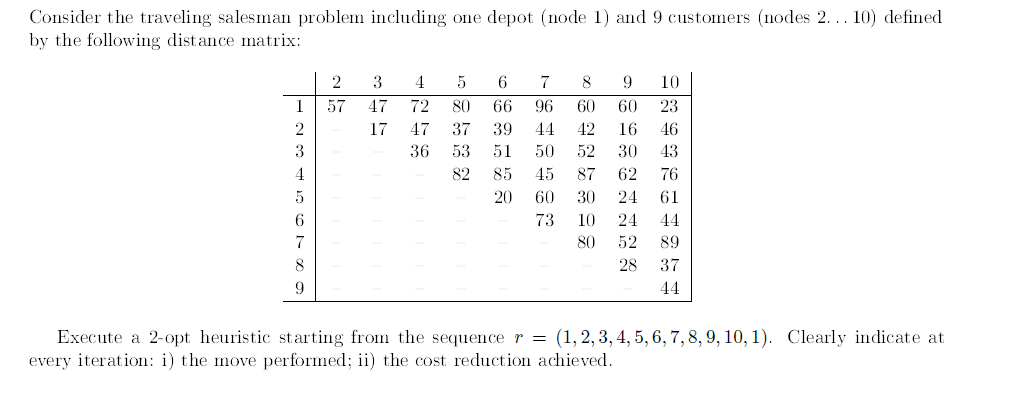
Question: Consider the traveling salesman problem including one depot (node 1 ) and 9 customers (nodes 2dots10 ) defined by the following distance matrix: table[[,2,3,4,5,6,7,8,9,10],[1,57,47,72,80,66,96,60,60,23],[2,,17,47,37,39,44,42,16,46],[3,,,36,53,51,50,52,30,43],[4,,,,82,85,45,87,62,76],[5,,,,,20,60,30,24,61],[6,,,,,,73,10,24,44],[7,,,,,,,80,52,89],[8,,,,,,,,28,37],[9,,,,,,,,,44]] Execute
Consider the traveling salesman problem including one depot (node 1 ) and 9 customers (nodes
2dots10) defined by the following distance matrix: \table[[,2,3,4,5,6,7,8,9,10],[1,57,47,72,80,66,96,60,60,23],[2,,17,47,37,39,44,42,16,46],[3,,,36,53,51,50,52,30,43],[4,,,,82,85,45,87,62,76],[5,,,,,20,60,30,24,61],[6,,,,,,73,10,24,44],[7,,,,,,,80,52,89],[8,,,,,,,,28,37],[9,,,,,,,,,44]] Execute a 2-opt heuristic starting from the sequence
r=(1,2,3,4,5,6,7,8,9,10,1). Clearly indicate at every iteration: i) the move performed; ii) the cost reduction achieved.
Step by Step Solution
There are 3 Steps involved in it
1 Expert Approved Answer
Step: 1 Unlock

Question Has Been Solved by an Expert!
Get step-by-step solutions from verified subject matter experts
Step: 2 Unlock
Step: 3 Unlock
 Study Help