







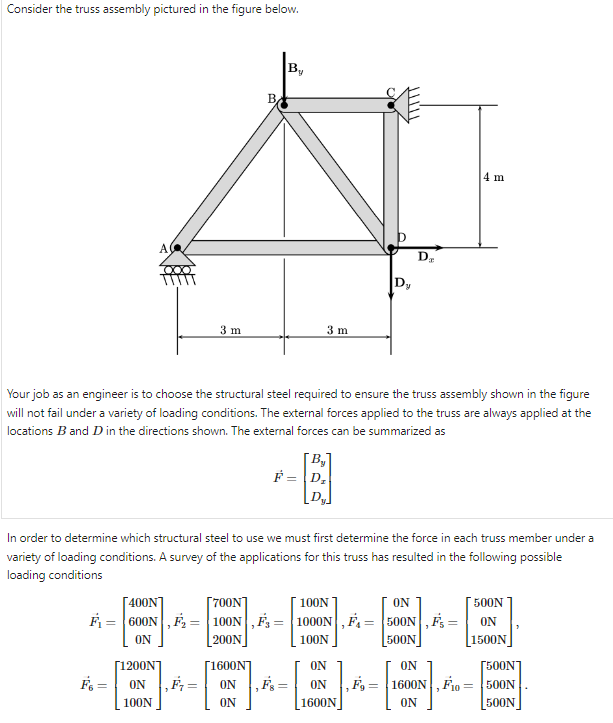
Question: Consider the truss assembly pictured in the figure below. Using either Gaussian elimination or LU Decomposition ( you can use your solution from assignment 1
Consider the truss assembly pictured in the figure below.
Using either Gaussian elimination or LU Decomposition you can use your solution from assignment andor assignment or the built in NumPySciPy implementations complete the function computelargestmemberforce below to efficiently solve for the forces in all members of the truss. Using this information determine what the maximum load compressive or tensile is in any member for each loading configuration, the largest force in magnitude in any member, and which member contains the largest force.
The function computelargestmemberforce should take a twodimensional NumPy array as the input argument. Each row of the input array corresponds to one of the loading conditions
So the array should be a by for these particular loads.
The function should return a threetuple that contains memberidstring, forceidstring, magnitudelargestforce where memberidstring is a string that labels the member that contains the largest force, so one of ADABBDCD or BC forceidstring is a string that labels the loading condition that gives rise to the maximum force so one of FFFFFFFFF or F magnitudelargestforce is the magnitude of the largest force in any member. So an example of what the function should return is ABF in that order!
If you use your assignment or codes and import them after converting to Python, make sure you add those files to the repository when you commit them.
Hint: You must first solve for the reaction at the pins of the entire truss in equilibrium. These reaction forces along with the externally applied loads can then be used with the Method of Sections or the Method of Joints to write the equilibrium equations for each member of the truss.
Additional photos that provide the soluition format still need to be attached...
Step by Step Solution
There are 3 Steps involved in it
1 Expert Approved Answer
Step: 1 Unlock

Question Has Been Solved by an Expert!
Get step-by-step solutions from verified subject matter experts
Step: 2 Unlock
Step: 3 Unlock
 Study Help